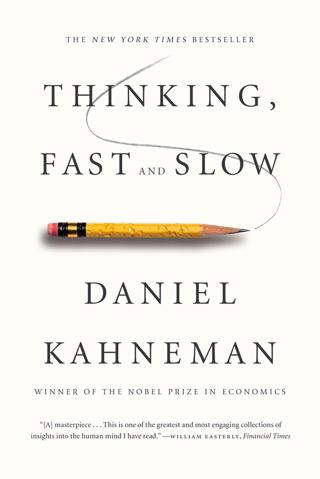
Critical Review of Thinking, Fast and Slow
By: Daniel Kahneman
One of the most significant criticisms concerns the replication crisis in psychology, which has affected several studies cited by Kahneman. Many key experiments in social psychology and behavioral economics, such as those on priming effects and anchoring biases, have failed to replicate reliably. Kahneman himself acknowledged this issue, especially in relation to priming studies, and even called for better replication efforts within the field. Critics argue that the reliance on potentially unreliable studies weakens some of the book’s claims about human decision-making.
Another critique is that Kahneman’s System 1 and System 2 model, which describes thinking as either fast and intuitive (System 1) or slow and deliberative (System 2), may be an oversimplification. Cognitive scientists argue that human thought processes are more fluid and interconnected than a strict dual-system model suggests. Research by Gigerenzer (2018) and others suggests that heuristics (often categorized as System 1 thinking) are not always irrational but can be adaptive and efficient. This challenges the idea that fast thinking is generally flawed and slow thinking is superior.
Additionally, some economists and psychologists have pointed out that the book downplays the role of learning, expertise, and context in decision-making. While Kahneman emphasizes cognitive biases as inherent flaws, researchers like Gerd Gigerenzer argue that these heuristics can often lead to good decisions in real-world environments. The book’s emphasis on human irrationality has also been criticized for being too pessimistic, with some suggesting it underestimates how people can improve their decision-making through experience and feedback.
In summary, while Thinking, Fast and Slow has made a lasting impact on psychology, behavioral economics, and decision-making studies, it is not without its flaws. The replication crisis, oversimplified cognitive models, and an overly negative view of heuristics have led some researchers to question parts of its framework. Nonetheless, the book remains an important contribution, even as ongoing research refines and challenges some of its core ideas.
<< Back to the book summary