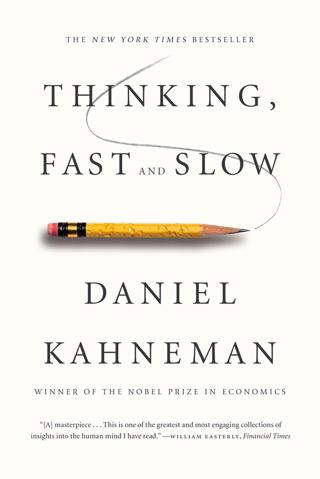
Thinking, Fast and Slow
By: Daniel Kahneman
Intro:
"Thinking, Fast and Slow" by Daniel Kahneman delves into the dual systems that govern how humans think and make decisions: System 1 and System 2. System 1 operates automatically and quickly, with little or no effort and no sense of voluntary control. It is intuitive, driven by emotion and instinct, and based on quick judgments. System 2, on the other hand, is slower, more deliberative, and more logical. It requires effort and attention, and is used for complex computations and conscious reasoning. Kahneman explores how these two systems shape our thoughts and behavior, influencing everything from everyday decisions to significant life choices. Kahneman, a psychologist and Nobel laureate, illustrates the strengths and weaknesses of each system through a series of cognitive biases and heuristics that affect judgment and decision-making. He explains phenomena such as the anchoring effect, where individuals rely heavily on the first piece of information they encounter, and the availability heuristic, where people judge the likelihood of events based on how easily examples come to mind. By drawing on decades of research and experiments, Kahneman reveals that much of what we think and do is surprisingly irrational, governed by shortcuts and biases inherent in System 1. The book also discusses the implications of these findings for fields such as economics, psychology, and public policy, advocating for greater awareness of cognitive biases in decision-making processes. Kahneman highlights the importance of designing environments that can improve decision-making by mitigating the effects of these biases. "Thinking, Fast and Slow" provides a comprehensive exploration of the mind’s inner workings, offering valuable insights into the complexities of human thought and the profound impact of cognitive psychology on our understanding of the world.
Part I: Two Systems
Chapter 1: The Characters of the Story Kahneman introduces the two fundamental systems of thought that drive human decision-making. *System 1* is quick, automatic, and emotional. It operates effortlessly, without conscious thought, and is responsible for our fast judgments and reactions. *System 2*, on the other hand, is slower, deliberate, and logical. It requires more mental effort and attention to process information. Kahneman explains that both systems interact constantly, but System 1 often dominates, leading to quick, intuitive decisions that are sometimes irrational or biased. The balance between these systems shapes the way we perceive the world and make choices.
Chapter 2: Attention and Effort This chapter delves into the concept of mental effort and the limits of our cognitive resources. Kahneman explains that System 2 requires a significant amount of mental energy, and our capacity to focus and deliberate is finite. When we engage in complex thinking or decision-making, we deplete our cognitive resources, leading to fatigue and less effective reasoning. Kahneman describes how this limited capacity affects our judgment and decision-making. For example, when we are tired or distracted, we are more likely to rely on the automatic, effortless System 1, which can lead to errors in thinking.
Chapter 3: The Lazy Controller In this chapter, Kahneman discusses the laziness inherent in System 2. System 2, while capable of rational, deliberate thought, is often reluctant to engage, preferring the easier, automatic responses generated by System 1. This tendency to avoid effort means that System 2 often only steps in when System 1's conclusions are obviously flawed or insufficient. Kahneman shows that our cognitive system will default to System 1 when it can, leading to biased thinking and poor decision-making unless we consciously override it. This laziness contributes to the prevalence of cognitive errors in our judgments.
Chapter 4: The Associative Machine Kahneman explores how System 1 operates through associations. It constantly makes connections between ideas, emotions, memories, and experiences, enabling us to quickly make sense of the world. However, these automatic associations often lead to biased or faulty conclusions. Kahneman illustrates this by showing how we might jump to conclusions or misunderstand situations based on past experiences, even when they are not entirely relevant. He highlights the dangers of relying on these automatic associations, as they can mislead us in important decisions.
Chapter 5: Cognitive Ease This chapter introduces the concept of cognitive ease, which refers to the ease with which information is processed. When things are easy to understand or recognize, we tend to believe them more readily, assuming that ease equals truth. Kahneman discusses how cognitive ease can influence our judgment and decision-making, making us more prone to trusting familiar ideas or comfortable patterns. The familiarity of information—whether through repetition, simple phrasing, or clarity—can create a sense of truthfulness, even when the information is not accurate or complete. This chapter demonstrates how cognitive ease shapes our everyday beliefs and behaviors.
Chapter 6: Norms, Surprises, and Causes In this chapter, Kahneman explores how our minds are wired to detect patterns, norms, and deviations from expectations. System 1 constantly scans the environment for signs of regularity, and when something unusual or surprising occurs, it often constructs a causal explanation to make sense of it. However, this tendency to create stories or causal links can lead to errors. Kahneman shows how this mental shortcut leads us to make false connections between events, attributing causes where there are none, or over-interpreting randomness as a meaningful pattern.
Chapter 7: A Machine for Jumping to Conclusions Here, Kahneman delves deeper into System 1’s tendency to make snap judgments based on limited information. While these quick judgments can often be helpful in familiar situations, they can also lead to significant errors when the situation requires careful thought or analysis. Kahneman explains that System 1 is designed to detect patterns quickly, but when it jumps to conclusions without sufficient evidence, it can lead to biased decisions. The chapter explores the consequences of this tendency and how it can influence our personal and professional lives, from interpreting social cues to making financial decisions.
Chapter 8: How Judgments Happen In this chapter, Kahneman examines the process by which intuitive judgments are made. System 1 draws from a vast reservoir of experiences, memories, and learned associations to form quick responses to stimuli. These judgments are often made unconsciously, with little awareness of the underlying processes. Kahneman explains that although these intuitive judgments are often accurate, they can also be flawed, as they are heavily influenced by biases such as availability and representativeness. He highlights how our judgments are shaped by our prior experiences and how this can lead to systematic errors.
Chapter 9: Answering an Easier Question Kahneman introduces the concept of the substitution heuristic in this chapter. When confronted with a difficult or complex question, System 1 often substitutes it with a simpler, related question that is easier to answer. This substitution can lead to errors because the simpler question may not fully address the original one. Kahneman discusses how this heuristic operates in everyday decision-making, leading us to simplify complex problems or overlook important details. He emphasizes how this shortcut can contribute to biases in judgments, such as overconfidence or faulty risk assessment.
Part II: Heuristics and Biases
Chapter 10: The Law of Small Numbers In this chapter, Kahneman examines our tendency to generalize from small samples, a cognitive error known as the "law of small numbers." People often believe that small samples are representative of a larger population, leading to faulty conclusions. For instance, when we observe an outcome based on a few instances, such as a small group of test subjects or a brief period of observation, we assume the pattern will hold true for the larger group. Kahneman explains how this bias can result in overconfidence in our judgments, and how people frequently overlook the importance of larger, more reliable sample sizes when making decisions.
Chapter 11: Anchors Kahneman delves into the concept of the anchoring effect, where our judgments and decisions are influenced by an initial piece of information (the "anchor"), even if that information is irrelevant or arbitrary. When asked to estimate a number or make a decision, people often unconsciously rely on the first number they encounter, such as a suggested price or an initial statistic, which skews their subsequent estimates. The chapter demonstrates how this bias impacts a wide range of decisions, from pricing strategies in business to judgments in legal settings, and discusses how it often leads to suboptimal choices.
Chapter 12: The Science of Availability This chapter explores the availability heuristic, which is our tendency to judge the likelihood of an event based on how easily we can recall examples of it. Kahneman explains that when an event or instance is vivid, emotionally charged, or recent in memory, it feels more likely to happen. For example, after watching a news story about a plane crash, we might irrationally fear flying, even though statistically it is one of the safest forms of travel. Kahneman discusses how the ease with which information comes to mind can distort our perception of risks and probabilities, leading us to make judgments based on saliency rather than facts.
Chapter 13: Availability, Emotion, and Risk In this chapter, Kahneman expands on the availability heuristic by linking it to emotion and risk perception. He shows how emotional experiences, such as fear or excitement, can enhance the availability of certain memories or scenarios, making them seem more probable. Kahneman illustrates how our emotional responses to events, particularly those involving risk (such as accidents or disasters), can distort our ability to accurately assess future risks. This emotional influence can lead to an overestimation of certain dangers and an underestimation of others, skewing our risk assessments and decision-making processes.
Chapter 14: Tom W's Specialty Kahneman discusses the representativeness heuristic in this chapter, which leads us to judge the likelihood of an event based on how closely it resembles a known prototype or stereotype. For example, when given a description of a person and asked to estimate their profession, we often make judgments based on how well the description fits our mental image of certain careers (e.g., a quiet, detail-oriented person being perceived as a librarian). This heuristic can lead to misjudgments, especially when we ignore base rates—the actual statistical likelihood of an event. Kahneman shows how representativeness leads to errors in predicting outcomes and making probabilistic judgments.
Chapter 15: Linda: Less is More Kahneman introduces the conjunction fallacy in this chapter, revealing how people often incorrectly judge specific scenarios as more probable than broader ones. In a well-known example, participants were asked whether it was more likely that Linda, a woman described as politically active and concerned about social justice, was a bank teller or a bank teller and active in the feminist movement. Many people erroneously judged the conjunction (bank teller and feminist) as more probable than the broader category (just a bank teller), even though the latter should always be more likely. Kahneman discusses the cognitive biases at play, particularly how people ignore basic statistical principles when making judgments about probabilities.
Chapter 16: Causes Trump Statistics In this chapter, Kahneman explores our preference for causal explanations over statistical reasoning, a bias that can lead to significant errors in judgment. People tend to favor stories or narratives that explain events, even when statistical data contradicts those stories. Kahneman highlights how this bias affects decision-making, especially in situations where data is more reliable than anecdotal evidence. For example, people might attribute a business failure to poor leadership or a personal failing, even when statistical data shows that industry-wide economic trends were the real cause. This chapter demonstrates the power of narrative and causality in shaping our beliefs and decisions.
Chapter 17: Regression to the Mean This chapter explains the statistical phenomenon of regression to the mean, which occurs when extreme outcomes are followed by more typical, average outcomes. Kahneman discusses how people fail to recognize this tendency and misinterpret it as a sign of skill or effort. For instance, a player who performs unusually well in one game is often expected to perform at the same high level in subsequent games, leading to misplaced praise or unrealistic expectations. Kahneman shows how failing to account for regression to the mean leads to faulty evaluations in many areas, from sports to education to business performance.
Chapter 18: Taming Intuitive Predictions In the final chapter of this part, Kahneman offers suggestions for improving predictive judgment. He explores the idea of integrating statistical data with intuitive thinking to create more accurate forecasts. While System 1's intuitive judgments are quick and useful in many cases, they can be faulty when it comes to predicting future events. Kahneman argues that by consciously incorporating statistical reasoning and focusing on base rates, people can improve their predictions and reduce bias. This chapter provides practical advice for how individuals and organizations can refine their decision-making processes by recognizing the limitations of intuition and enhancing it with empirical data.
Part III: Overconfidence
Chapter 19: The Illusion of Understanding In this chapter, Kahneman explores the "illusion of understanding," a cognitive bias that causes people to believe they comprehend complex events or situations more deeply than they actually do. This illusion arises because humans tend to create simplified, coherent narratives to explain the world around them. These narratives make events seem more predictable and understandable, even when they are, in fact, governed by randomness or complexity. Kahneman emphasizes that this bias can lead to overconfidence, especially in fields like finance or politics, where people often convince themselves they understand the causes of outcomes when they really don’t. This false sense of certainty can hinder accurate decision-making and risk assessment.
Chapter 20: The Illusion of Validity Kahneman extends the discussion of overconfidence by focusing on the "illusion of validity," the tendency for people to believe that their judgments are more accurate than they actually are. This illusion arises when individuals are confident in their intuitive decisions, even in situations where the evidence contradicts their beliefs. Kahneman explains how people become overly reliant on their gut feelings, often disregarding statistical data or objective facts. The chapter reveals how this bias leads to poor judgment and explains why some experts and professionals are particularly prone to this illusion, especially when they have a track record of success, which reinforces their confidence despite errors.
Chapter 21: Intuitions vs. Formulas Kahneman compares intuitive judgment with statistical formulas in this chapter. He explains that, contrary to popular belief, statistical formulas often outperform human judgment, especially when it comes to predictions. Kahneman presents evidence that formulas, based on historical data, can produce more accurate and reliable predictions than experts who rely on their intuition. The chapter emphasizes the limitations of human cognition, particularly when dealing with complex and uncertain situations, where intuitive judgments can lead to significant errors. Kahneman advocates for the use of statistical methods, especially in decision-making processes like hiring, medical diagnoses, and financial forecasting, where accuracy is crucial.
Chapter 22: Expert Intuition: When Can We Trust It? In this chapter, Kahneman discusses the conditions under which expert intuition can be trusted. He explains that expert intuition is most reliable in environments that are stable, predictable, and based on repeated patterns. When experts work in such environments for a long time, they develop a form of "intuition" that allows them to make accurate judgments based on subtle cues. However, Kahneman points out that in unpredictable or novel situations, expert intuition can be just as fallible as that of novices. He stresses that expertise is only valuable when it is applied within well-defined and consistent systems, and warns against over-relying on intuition in complex or uncertain contexts.
Chapter 23: The Outside View Kahneman introduces the concept of the "outside view" in this chapter. He explains that, when making predictions or decisions, individuals often fall prey to biases that arise from their personal experiences or limited knowledge. The outside view, by contrast, encourages individuals to use statistical data and historical comparisons to make more objective judgments. By looking at how similar situations have played out in the past, the outside view helps counteract the biases of overconfidence and optimism. Kahneman argues that adopting the outside view is essential for more accurate decision-making, especially in forecasting complex or uncertain outcomes like project timelines or investment returns.
Chapter 24: The Engine of Capitalism In this chapter, Kahneman discusses how optimism bias acts as a driving force in business and economic activities. He explains that people are naturally inclined to believe that good things will happen to them, often leading to overly optimistic predictions about their personal or professional ventures. This optimism is a fundamental component of capitalism, as entrepreneurs and investors must maintain a positive outlook to take risks and pursue opportunities. However, Kahneman warns that this bias can often lead to unrealistic expectations, poor risk assessment, and overconfidence in business decisions. He suggests that while optimism is necessary for innovation and growth, it should be tempered with more grounded, realistic assessments of the risks involved.
Part IV: Choices
Chapter 25: Bernoulli's Errors Kahneman critiques the classical economic theory of utility, introduced by Daniel Bernoulli, in this chapter. Bernoulli's utility theory assumes that people make choices based on the perceived utility or value of outcomes, which is determined by the final state of affairs. However, Kahneman points out that this theory does not account for the psychological factors that influence decision-making, particularly the way people evaluate gains and losses. He demonstrates that people’s choices are not always driven by rational calculations of final outcomes but are heavily influenced by subjective emotions, the framing of options, and relative comparisons. Kahneman suggests that Bernoulli's model, while foundational, oversimplifies human behavior, ignoring biases such as loss aversion and reference points.
Chapter 26: Prospect Theory In this chapter, Kahneman introduces prospect theory, which challenges traditional economic models of decision-making. Prospect theory shows that people's choices are more strongly influenced by potential losses and gains relative to a reference point, rather than the final outcome itself. The theory explains that individuals experience losses more intensely than equivalent gains, a concept known as loss aversion. Kahneman uses prospect theory to demonstrate that people tend to make irrational decisions when faced with risk, often taking greater risks to avoid losses than to achieve gains. The chapter explores how prospect theory provides a more accurate framework for understanding real-world decision-making than the utility theory.
Chapter 27: The Endowment Effect Kahneman discusses the endowment effect, a cognitive bias where people assign higher value to items they own than to equivalent items they do not own. This effect challenges traditional economic theories, which assume that individuals should be indifferent to ownership. Kahneman explains that the mere act of owning something increases its perceived value, leading people to demand more money to sell something than they would be willing to pay to acquire it. The chapter explores the psychological mechanisms behind this bias, showing how ownership can distort people's perceptions and decisions in a variety of contexts, from consumer goods to financial investments.
Chapter 28: Bad Events This chapter examines the human tendency to place greater weight on negative experiences or losses compared to positive ones, a concept known as loss aversion. Kahneman explains how people are more sensitive to bad events and losses than they are to good ones and how this asymmetry influences decision-making. The chapter emphasizes that this bias is not limited to personal experiences but extends to how people evaluate economic situations, relationships, and even risk. Loss aversion can lead to decisions that prioritize avoiding losses rather than maximizing gains, such as holding on to losing investments for too long or overvaluing the avoidance of negative outcomes.
Chapter 29: The Fourfold Pattern Kahneman introduces the fourfold pattern of risk attitudes, which describes how people's risk preferences change based on the probability of gains and losses. He explains that people are generally risk-averse when faced with potential gains, preferring a sure but smaller gain over a larger, uncertain one. However, when faced with potential losses, they tend to be risk-seeking, willing to take greater risks in hopes of avoiding a loss. This pattern shifts again depending on the probability of the outcome: people are more risk-averse when the likelihood of a gain is high, and more risk-seeking when the likelihood of a loss is high. Kahneman illustrates how these patterns of behavior are inconsistent and irrational, demonstrating the influence of framing effects and psychological factors on decision-making.
Chapter 30: Rare Events In this chapter, Kahneman explains how people tend to overestimate the likelihood of rare events, especially those that are emotionally vivid or dramatic. This bias, driven by the availability heuristic, causes individuals to place disproportionate weight on rare events when making judgments about risk. Kahneman shows how people’s memories of dramatic events, such as natural disasters or terrorist attacks, distort their perceptions of risk and lead them to make decisions that are not based on statistical reality. He also explores how the media and emotional experiences amplify this effect, influencing everything from public policy to personal investment decisions.
Chapter 31: Risk Policies Kahneman suggests that to improve decision-making, individuals should adopt broad risk policies rather than making ad-hoc decisions based on specific circumstances. He explains that relying on broad guidelines helps individuals avoid the biases and inconsistencies that can arise when making decisions case by case. These policies could be applied in a variety of contexts, such as investment strategies, healthcare decisions, or business practices. Kahneman emphasizes that having a well-defined policy in place helps to mitigate the impact of emotional biases and leads to more rational decision-making, especially in situations involving uncertainty and risk.
Chapter 32: Keeping Score This chapter examines how mental accounting affects people's economic decisions. Mental accounting is the tendency to categorize and treat money or resources differently depending on their source, purpose, or intended use. Kahneman discusses how people keep mental "scorecards" to track gains and losses, often treating different accounts or budgets as separate, even when doing so is irrational. For example, individuals may splurge on a luxury item with money received as a gift, while being more frugal with their own money, even if the total available funds are the same. The chapter explores how this behavior leads to inconsistent financial decisions and inefficient resource allocation.
Chapter 33: Reversals In this chapter, Kahneman explores preference reversals, which occur when individuals change their preferences depending on how options are framed or presented. He demonstrates how people's decisions are not always consistent, even when the underlying choices are the same. For instance, people may express a preference for a certain option when it is presented in one way but reverse their preference when the same option is framed differently. Kahneman discusses how framing effects can lead to irrational decision-making and reveal inconsistencies in people's preferences, highlighting the impact of psychological biases on choice behavior.
Chapter 34: Frames and Reality The final chapter of the part focuses on how the way information is framed influences our decisions. Kahneman explains that different ways of presenting the same facts can lead to different choices. This framing effect is a powerful cognitive bias that shapes how people perceive risk, value, and outcomes. He illustrates how individuals' preferences can be swayed by subtle changes in language, context, or presentation, even when the objective reality remains unchanged. The chapter shows how framing effects can lead to inconsistent and often irrational decisions, and it emphasizes the importance of being aware of this bias in order to make better, more informed choices.
Part V: Two Selves
Chapter 35: Two Selves In this chapter, Kahneman introduces the concept of the experiencing self and the remembering self. The experiencing self is the part of us that lives in the present moment, perceiving and reacting to events as they occur. It is responsible for our immediate sensations, emotions, and experiences. In contrast, the remembering self is the part of us that reflects on and evaluates those experiences after they have passed. The remembering self constructs a narrative of our lives based on these reflections, often distorting the true nature of the original experience. Kahneman discusses how these two selves often have different perceptions of the same events, and how this discrepancy can influence our decisions and our overall sense of well-being. He explores the implications of this distinction for understanding happiness, satisfaction, and memory.
Chapter 36: Life as a Story Kahneman elaborates on the idea that people perceive their lives as stories, focusing on key moments that stand out in memory, such as peak experiences and endings. He explains that, when recalling life events, we tend to remember the most intense (peak) moments and the final moments (endings), often disregarding the duration or the overall quality of the experience. This tendency can lead to distorted views of our lives, as we assign more weight to certain moments than is warranted. Kahneman uses this framework to explore how our memories shape our understanding of happiness and success, and how we construct our personal narratives based on these select memories, often overlooking the richness of the experiences in between. The chapter highlights the cognitive biases that influence our memory and the way we interpret the story of our lives.
Chapter 37: Experienced Well-Being In this chapter, Kahneman examines the concept of experienced well-being, which refers to how we feel during the course of our experiences, versus remembered well-being, which refers to how we recall those experiences afterward. He explores the challenges involved in measuring well-being, noting that people tend to overestimate the impact of certain events on their long-term happiness based on the remembering self's retrospective view. Kahneman discusses the limitations of traditional measures of happiness, such as life satisfaction surveys, and argues that experienced well-being—how we feel moment by moment—is a more accurate gauge of true well-being. He also explores how the experiencing self and remembering self often lead to different conclusions about the quality of life, revealing the complexities involved in understanding human happiness and satisfaction.
Chapter 38: Thinking About Life The book concludes with reflections on how our thoughts about life shape our well-being. Kahneman synthesizes the insights from earlier chapters, emphasizing that both the experiencing self and remembering self play crucial roles in how we perceive our lives. He argues that our thoughts about past events and future possibilities significantly influence our sense of happiness, yet these thoughts are often biased by cognitive errors and heuristics. Kahneman stresses that by understanding the two selves and the discrepancies between them, individuals can make more informed decisions about how to live a fulfilling life. The chapter offers suggestions for enhancing well-being by aligning the goals and desires of the experiencing self with the remembered self's idealized narratives. Kahneman closes the book by reflecting on the complexity of human decision-making and the profound implications of biases, memory, and perception on how we live and understand our lives.