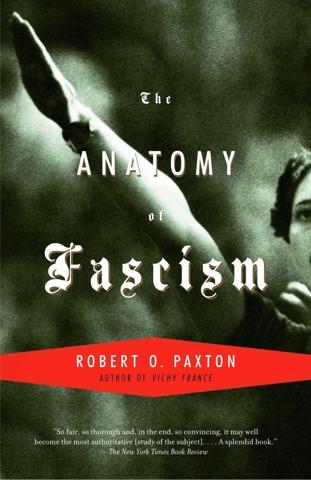
Critical Review of The Anatomy of Fascism
By: Robert Paxton
The Anatomy of Fascism by Robert O. Paxton is a comprehensive analysis of the nature and characteristics of fascism, and while it is widely regarded as a significant scholarly work, it has not been immune to critique. Some criticisms stem from the interpretive nature of Paxton's approach. By focusing on a "process" rather than a static definition of fascism, some critics argue that his framework can be too broad or flexible, potentially encompassing a range of movements and regimes that may not fit neatly within the paradigm of classic fascism.
One specific area of critique involves Paxton's decision to include both historical and potentially contemporary movements in his analysis. This has led some scholars to argue that such an approach risks diluting the specificity of historical fascism by drawing parallels that might overlook critical contextual differences. Critics suggest that while the attempt to create a fluid understanding of fascism is useful for contemporary political analysis, it can also blur the distinct historical contexts and ideological variations seen in different fascist movements throughout history.
Another point of contention is Paxton's relative underemphasis on the role of ideology in fascist movements. Some historians and political scientists argue that Paxton's approach underestimates the power of ideology and the extent to which it can shape both the actions of fascist regimes and the perception of them by the public. While Paxton stresses the importance of actions and dynamics over ideology, critics argue that ideology itself plays a crucial role in legitimizing fascist rule and mobilizing support.
Additionally, Paxton's framework has been critiqued for its application to non-European contexts. While "The Anatomy of Fascism" primarily focuses on European examples, its broader implications have led to debates over whether his criteria can be effectively applied to movements in other parts of the world. Critics argue that applying Paxton’s model to non-Western contexts without sufficient adaptation might ignore regional and cultural specificities, thus misrepresenting local political phenomena.
Overall, while "The Anatomy of Fascism" is praised for its insightful and dynamic framework, criticisms often center on its interpretive flexibility, its treatment of ideology, and the challenges of its broader applicability. Nonetheless, despite these critiques, Paxton's work remains a seminal text in fascist studies, contributing significantly to our understanding of how fascist movements operate and evolve.
<< Back to the book summary