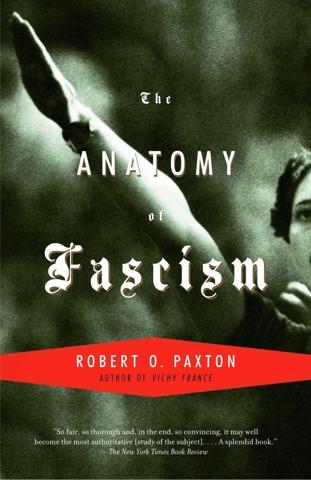
The Anatomy of Fascism
By: Robert Paxton
Intro:
The Anatomy of Fascism by Robert O. Paxton is a comprehensive exploration of the origins, development, and characteristics of fascism as a political ideology. Paxton, a renowned historian and political scientist, delves into the complex elements that constitute fascism, drawing on real-world historical examples to illustrate its manifestations. The book challenges the reader to consider fascism not as a static ideology confined to a strict definition, but as a dynamic movement that evolves in response to specific historical and socio-political contexts. Paxton's analysis is rooted in a detailed examination of how fascist movements gained traction in Europe, particularly in countries like Italy and Germany, where they rose to power in the early to mid-20th century. Paxton eschews a traditional, definition-heavy approach and instead focuses on the functions and practices of fascist regimes, emphasizing action over ideological purity. This allows him to dissect the core techniques used by fascist movements, such as the exploitation of nationalist sentiment, the use of propaganda, the coordination of paramilitary groups, and the manipulation of democratic processes. Paxton also highlights how fascist movements often benefitted from the complicity or active support of established elites who sought to use them as tools to protect their own interests against leftist threats. Through this analysis, "The Anatomy of Fascism" presents a nuanced understanding of how fascism is less about fixed doctrines and more about a method of achieving and maintaining power. The book's approach encourages readers to critically assess the conditions under which fascism can emerge and the warning signs that may indicate its rise. Paxton underscores the importance of understanding the sociopolitical climates that foster fascist movements, thus offering insights into preventing its resurgence. By combining detailed historical narrative with theoretical examination, "The Anatomy of Fascism" serves as both an informative study of past fascist states and a cautionary tale for contemporary political landscapes, making it a vital resource for understanding one of the 20th century's most destructive phenomena.
The Anatomy of Fascism by Robert O. Paxton is a landmark study that examines the various elements that make up fascist movements, their dynamics, and their historical context. It breaks down the elusive and complex phenomenon of fascism into identifiable components and processes, providing a comprehensive understanding of how fascism emerges, evolves, and ultimately maintains power. Paxton's work is methodical and extensively supported by historical evidence, engaging readers in a detailed narrative that spans across several European experiences primarily focused on the 20th Century. Here is an extensive summary of the book's chapters:
Chapter 1: Introduction
In the introduction, Paxton sets the stage by explaining the challenges of defining fascism. He critiques existing definitions that emphasize ideology at the expense of examining actual historical instances where fascism has arisen. Paxton argues that fascism is better understood through its function rather than its theory, pushing for an analysis rooted in historical action and consequence rather than purely abstract principles. He introduces his core thesis: that fascism is a process more than a stable entity, demonstrating a set of political behaviors that appear during certain crises.
Chapter 2: Creating Fascist Movements
Paxton delves into the creation of fascist movements, investigating the socio-political conditions that make fascist ideologies appealing. He examines the disillusionment with liberal democracy and the strains of World War I as precursors to fascism’s rise in Italy and Germany. Paxton explores how early fascist movements capitalized on post-war grievances, presenting themselves as new, revolutionary alternatives to the status quo. The chapter details the initial movement building phase, often characterized by violence, nationalism, and charismatic leadership.
Chapter 3: Taking Root
This chapter explores how fascist movements transition into legitimate political players. Paxton describes the strategic alliances formed with conservative elites, military figures, and industrialists, who see fascists as a means to stave off socialism and strengthen national unity. The support of these traditional power bases grants fascist movements the new resources and credibility needed to expand further. The chapter highlights the importance of propaganda and mass mobilization in cultivating broad-based support, changing the sociopolitical landscape to the advantage of the fascists.
Chapter 4: Getting Power
Here, Paxton analyzes the critical juncture when fascist movements seize state power. He provides detailed historical examples of how the Nazi and Fascist parties in Germany and Italy respectively maneuvered through existing political systems, exploiting weaknesses, employing intimidation, and using electoral processes to secure control. The chapter emphasizes the importance of both legal avenues and extraordinary measures, such as terror and coup tactics, in achieving political domination. Paxton underscores the dynamic interplay of legality and coercion in this phase.
Chapter 5: Exercising Power
Once in power, fascist regimes face the challenge of governance consistent with their radical ideologies. Paxton discusses how fascist states consolidate control by reshaping state institutions and society. He delves into measures that maintain power, such as propaganda, the creation of a police state, and the integration of party and government. The chapter also addresses internal contradictions, like economic policies balancing radical rhetoric with pragmatic concerns. Paxton points out the importance of foreign policy, militarization, and societal re-engineering efforts to solidify power.
Chapter 6: radicalization and degeneration
This chapter discusses the tendency of fascist regimes to become more radical over time as they try to maintain momentum and engage their core supporters. Paxton analyzes how these regimes often pursue increasingly extreme policies, both domestically and internationally, which can lead to their overreach and eventual downfall. Examples like the invasion of the Soviet Union by Nazi Germany illustrate the self-destructive nature of such extremism. The authoritarian structure and emphasis on expansionist policies eventually lead to debilitating warfare and internal decay, hastening the collapse of fascist governments.
Chapter 7: Conclusion
In the conclusion, Paxton reflects on the nature of fascism and its legacy in modern times. He summarizes key traits of fascism, such as its populist ultra-nationalism, focus on cleansing the nation, and use of violence as a political tool. Paxton warns against underestimating the potential for fascism in contemporary societies facing crises similar to those of the past. By grounding fascism in its behavior and effect rather than static ideology, Paxton leaves readers with a framework to recognize and understand potential fascist movements in any era.
Overall, "The Anatomy of Fascism" combines a strong historical foundation with a novel approach to understanding fascism, offering insights that are both scholarly and accessible. Paxton’s focus on practical actions and broader societal contexts over strict ideological definitions provides a robust narrative on how fascism can manifest in various sociopolitical environments.