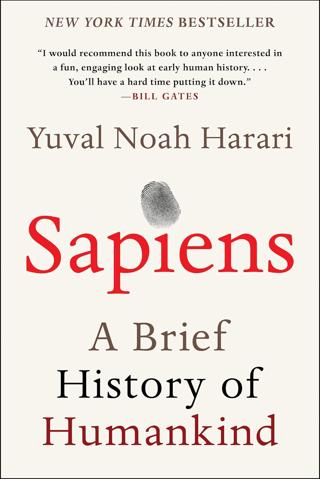
O revizie critică a cărții Sapiens
A Brief History of Humankind
De: Yuval Noah Harari
"Sapiens: A Brief History of Humankind" by Yuval Noah Harari has been widely acclaimed for its engaging narrative and ambitious scope, covering the history of Homo sapiens from the dawn of the species to the modern age. However, some scholars and critics have pointed out several scientific and methodological issues with the book.
One primary criticism is Harari's reliance on broad generalizations and speculative assertions that lack empirical support. While the book is meant to be a synthesis of history and science, some critics argue that Harari occasionally oversimplifies complex scientific ideas to fit his narrative framework. For instance, Harari discusses the Cognitive Revolution as a pivotal moment when Homo sapiens developed unique capacities for imagination and communication, but some scholars contend this explanation is overly simplified and not fully supported by archaeological and anthropological evidence.
Another point of contention is Harari's treatment of biology and evolution. Critics have noted that Harari sometimes uses evolutionary psychology in a way that can be considered speculative, applying modern human behaviors and societal structures back onto our prehistoric ancestors without enough rigorous backing. This method can lead to deterministic conclusions—suggesting that many aspects of modern life are inevitable results of evolutionary history, which is a point of ongoing debate among scientists.
Additionally, Harari has been critiqued for his approach to historical causality. The narrative style of "Sapiens" integrates disparate historical events into a single thread, sometimes glossing over the nuances and contingencies that define historical processes. Historians have pointed out that Harari's framing might give readers a false sense of inevitability regarding the development of human societies and the rise of certain global powers, which in reality results from a complex interplay of factors.
Finally, some have raised concerns about Harari's speculative future projections. His discussions around biotechnology, artificial intelligence, and the future of Homo sapiens, while thought-provoking, stray from the historical framework and enter the realm of futurism. Critics argue that these sections rely heavily on conjecture and are more reflective of current technological anxieties than grounded scientific predictions. While "Sapiens" is successful in sparking public interest and dialogue about human history, readers are advised to be mindful of its speculative nature and the balance between scientific evidence and narrative storytelling.
<< Înapoi la rezumatul cărții