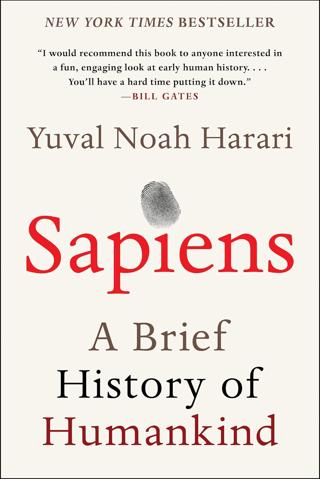
Sapiens
A Brief History of Humankind
De: Yuval Noah Harari
Introducere:
"Sapiens: A Brief History of Humankind," written by Yuval Noah Harari, offers a sweeping exploration of the history of our species, Homo sapiens, from the emergence of archaic human species up to the present day. Harari delves into pivotal developments such as the Cognitive Revolution, the Agricultural Revolution, the unification of humankind, and the Scientific Revolution, examining how these transformations have shaped societies and the world at large. With a compelling narrative that bridges science and the humanities, Harari challenges readers to reflect on the profound impact of cultural and technological progress on human civilization and consider the future trajectory of our species.
Sapiens: A Brief History of Humankind is a profound and provocative book by Yuval Noah Harari that explores the history of humankind from the Stone Age up to the modern era. Harari presents a wide-ranging overview of how Homo sapiens became the dominant species on Earth, illustrating the key transitions that have shaped human societies.
Part One: The Cognitive Revolution
Harari begins by detailing the Cognitive Revolution that occurred about 70,000 years ago, setting Homo sapiens apart from other species. This period was marked by the development of unique human abilities, particularly abstract thinking, complex language, and the capacity to create shared myths. These abilities allowed early humans to organize in larger groups, innovate, and dominate other species.
Part Two: The Agricultural Revolution
The book continues by examining the Agricultural Revolution around 10,000 years ago, which transformed human societies. This transition from foraging to farming led to the establishment of permanent settlements, population growth, and the creation of complex societies. However, Harari argues that this shift also brought about social hierarchies, private property, and new forms of inequality.
Part Three: The Unification of Humankind
In this section, Harari discusses how human societies began to unify culturally and politically through the development of money, empires, and religions. He elaborates on the concept of imagined orders—shared myths and collective fictions like law, nations, and corporations—that enabled large groups of humans to cooperate on a large scale.
Part Four: The Scientific Revolution
Harari turns to the Scientific Revolution, beginning in the 16th century, which initiated a new era of exploration and understanding. This period was characterized by unprecedented progress in science and technology, leading to the Industrial Revolution, capitalism, and modern states. The rise of empirical science and experiments allowed humans to vastly increase their power over the environment and other species.
Conclusion
In concluding, Harari reflects on the current status of Homo sapiens as a dominant species that has achieved god-like powers. He raises moral questions about the future, considering issues such as genetic engineering, artificial intelligence, and humanity's ongoing impact on the biosphere. Harari poses profound questions about happiness, ethics, and the ultimate direction of human progress.
Throughout Sapiens, Harari successfully weaves history, science, and philosophy into a compelling narrative that challenges readers to consider how our past shapes our present and future.