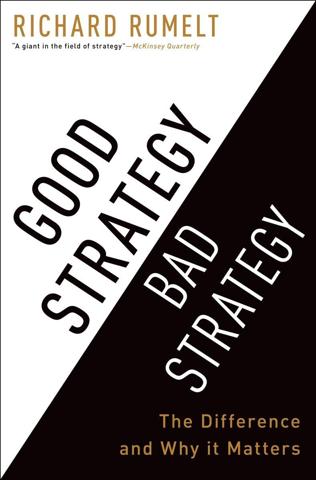
Good Strategy Bad Strategy
The Difference and Why It Matters
De: Richard Rumelt
Introducere:
Good Strategy Bad Strategy: The Difference and Why It Matters by Richard Rumelt offers a clear distinction between effective and ineffective strategies in business and beyond. Rumelt argues that a good strategy is focused, practical, and based on insight, while a bad strategy often relies on vague goals, buzzwords, and wishful thinking. Through real-world examples and a thorough analysis, the book highlights the importance of identifying key challenges and leveraging strengths to create impactful strategies. It's an essential read for leaders and decision-makers looking to sharpen their strategic thinking and achieve lasting success.
Introduction
The introduction sets the stage for the book, discussing the crucial differences between good and bad strategy. Rumelt emphasizes that strategy is not about setting broad ambitions but about making concrete, actionable decisions that address pivotal challenges.
Chapter 1: Good and Bad Strategy
This chapter defines what constitutes a good strategy and why bad strategies are prevalent. Good strategy focuses on diagnosing the issue, formulating a guiding policy, and crafting coherent actions. In contrast, bad strategy is characterized by fluff, failure to face challenges, and setting ambitious goals without clear means of achieving them.
Chapter 2: Discovering Power
Rumelt discusses the power of a good strategy and explains how the right strategy can help an organization achieve breakthroughs. He highlights the importance of identifying and leveraging sources of power within the organization, such as market insights or organizational capabilities.
Chapter 3: The Kernel of Good Strategy
The kernel of a good strategy consists of three elements: a diagnosis of the problem, a guiding policy to address the problem, and coherent actions to carry out the policy. Rumelt explains how these elements work together to form a strong strategic foundation.
Chapter 4: Diagnose
This chapter explores the first element of the strategy kernel: diagnosis. A good diagnosis simplifies the challenge by identifying the critical aspects that need to be addressed. Rumelt provides examples of effective diagnoses that have led to successful strategic decisions.
Chapter 5: Guiding Policy
Rumelt explains the second element of the strategy kernel: the guiding policy. This comprises the overall approach to overcoming obstacles identified in the diagnosis. A robust guiding policy directs energy and resources while leaving room for flexibility and adaptation.
Chapter 6: Coherent Actions
The third element of the strategy kernel, coherent actions, involves the specific steps taken to implement the guiding policy. Rumelt emphasizes the importance of consistency and coherence in actions across the organization to achieve strategic objectives effectively.
Chapter 7: Using Leverage
This chapter delves into the concept of leverage in strategy, focusing on how organizations can achieve significant results with limited resources. Rumelt highlights the importance of identifying leverage points that can create powerful effects, making a substantial impact with strategic maneuvers.
Chapter 8: Proximate Objectives
Rumelt explains the necessity of establishing proximate, or achievable, objectives within a strategic framework. These objectives act as stepping stones, helping the organization build momentum and reach long-term goals through a series of tangible, short-term accomplishments.
Chapter 9: Chain-link Systems
This chapter addresses the concept of chain-link systems, where the success of the strategy relies on the strength of interdependent components. Rumelt covers the importance of synchronizing different elements within an organization to create a cohesive and effective strategy.
Chapter 10: Using Design
Rumelt discusses the role of design in strategy formulation, illustrating how thoughtful design can foster creativity and innovation. Strategic design involves planning and structuring the way resources and processes are employed to achieve desirable outcomes.
Chapter 11: Focus
The chapter focuses on the principle of concentration in strategy, emphasizing that focusing resources and efforts on a key priority or problem is essential for strategic success. Rumelt argues that dilution of focus can scatter effort and reduce the impact of strategic actions.
Chapter 12: Growth
Rumelt questions common assumptions about growth as a strategic objective. He discusses the potential pitfalls of pursuing growth for growth's sake and encourages organizations to consider growth as a result of other strategic objectives rather than the main goal.
Chapter 13: Using Advantage
This chapter outlines how organizations can identify and exploit competitive advantages in their strategy formulation. Rumelt explains different types of advantages and how recognizing them can inform strategic decisions that lead to improved market positioning.
Chapter 14: Using Dynamics
Rumelt covers how organizations can use dynamics—including changes in technology, market conditions, and competitor behavior—to their advantage. Understanding these dynamics can help organizations anticipate future challenges and opportunities as they formulate their strategies.
Chapter 15: Inertia and Entropy
This chapter discusses organizational inertia and entropy as barriers to effective strategy. Rumelt warns against the dangers of complacency and how organizations can become trapped by their past successes, failing to adapt to new realities.
Chapter 16: Putting it All Together
The final chapter synthesizes the concepts and ideas presented throughout the book. Rumelt offers practical advice on how to create and implement a robust strategy by applying the principles of diagnosis, guiding policy, and coherent action.