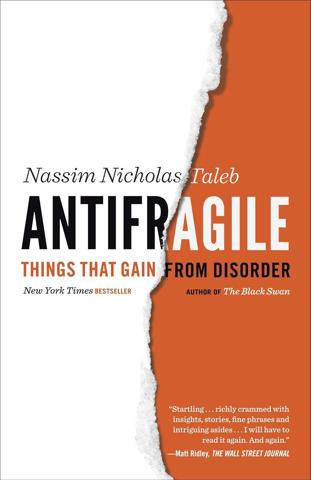
Critical Review of Antifragile
Things That Gain from Disorder
By: Nassim Nicholas Taleb
"Antifragile: Things That Gain from Disorder" by Nassim Nicholas Taleb has sparked significant discussion and criticism, both from within academia and beyond. One of the primary critiques of the book is its broad, somewhat unfocused use of the term "antifragility." While Taleb introduces a compelling concept—systems that benefit from stressors, shocks, or volatility—critics argue that the book lacks rigorous scientific methodology to consistently define and measure antifragility across different contexts. For example, Carl Bergstrom, a biologist, pointed out that the idea, although intriguing, wasn't backed by enough empirical examples and precise definitions to make it methodologically useful in scientific contexts.
Another critique focuses on Taleb's sometimes dismissive attitude toward certain fields, such as traditional economics, which he regularly critiques throughout the book. Some scholars believe that his approach is overly confrontational and disregards constructive dialogue needed to integrate valuable insights from existing frameworks. Additionally, Taleb's narrative style often includes personal anecdotes and polemics, which, while engaging, may obscure the theoretical foundations of his arguments and can detract from the academic rigor expected in scholarly discourse.
Critics have also noted that while Taleb's examples—ranging from evolutionary biology to financial markets—are vivid, they sometimes suffer from confirmation bias. Taleb's tendency to focus predominantly on instances that neatly fit his theory raises questions about the comprehensiveness and objectivity of his evidence. This concern highlights a need for more balanced exploration of counterexamples or cases where antifragility may not play a significant role, or where adaptive resilience rather than antifragility could account for a system's success or survival.
Moreover, despite the innovative nature of the antifragility paradigm, some critics have pointed out that Taleb could have embedded his ideas more thoroughly within existing literature on complex systems and resilience. They argue that the book might have benefited from engaging more with established theories and frameworks, which could have provided additional credibility and context to his claims. This engagement might have also helped bridge the gap between Taleb's ideas and their applicability in practical, real-world settings, contributing to more actionable insights for policymakers and practitioners.
In summary, while "Antifragile" offers a provocative and novel lens through which to view uncertainty and volatility, the book's impact and utility are subjects of debate. The criticisms reflect concerns about the scientific rigor, methodological clarity, and integration with existing research fields, which are essential for academic acceptance and practical application of the antifragility concept. Nonetheless, Taleb's work continues to inspire discussions about how systems cope with and even thrive amid uncertainty, contributing to ongoing dialogues in fields ranging from finance to biology.
<< Back to the book summary