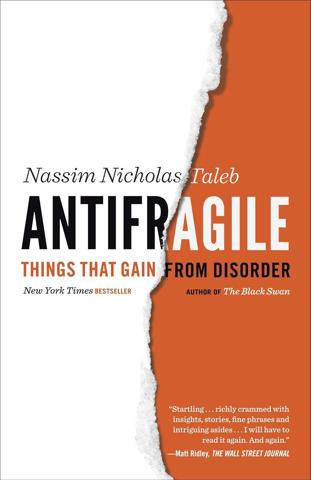
Antifragile
Things That Gain from Disorder
By: Nassim Nicholas Taleb
Intro:
"Antifragile: Things That Gain from Disorder" by Nassim Nicholas Taleb is a thought-provoking exploration into the concept of antifragility, which is the idea of things that gain or improve when exposed to volatility, shocks, stressors, and chaos. Unlike objects or systems that are simply robust or resilient, which resist change and remain the same under stress, antifragile systems thrive and grow when confronted by disorder. Taleb's work challenges traditional notions of stability and resilience, urging readers to reconsider how they interact with risk and uncertainty in their personal and professional lives.
The book is structured in a way that not only describes the concept of antifragility in various contexts but also provides practical advice on how to incorporate antifragile principles into everyday decision-making. Using a mix of philosophical reflections, historical anecdotes, and practical examples from domains such as economics, finance, and medicine, Taleb demonstrates how antifragility can be applied to improve outcomes and foster growth. He highlights how certain industries, individuals, and societies have historically benefited from unforeseen events and contrasts these with ones that crumble in the face of unpredictability.
Taleb's style is both insightful and provocative, encouraging readers to embrace uncertainty rather than fear it. He critiques the overreliance on predictive models and emphasizes the importance of adapting to changing circumstances. By nurturing antifragility, individuals and organizations can better prepare for the unpredictable nature of the world, finding opportunity in disruption rather than succumbing to it. The book's relevance extends beyond academic circles, offering valuable insights for anyone interested in thriving amidst the complexities of modern life.
Antifragile: Things That Gain from Disorder is a philosophical and practical exploration of systems, people, businesses, and concepts that benefit and grow stronger from volatility, randomness, and disorder. Taleb introduces the groundbreaking concept of antifragility, which is distinct from resilience or robustness as it describes systems that actually improve from shocks rather than merely endure them.
Chapter 1: Between Damocles and Hydra
Taleb starts by setting the stage for understanding antifragility by contrasting it with fragility and robustness. He introduces the mythical figure of Damocles, whose position conveys the essence of fragility: potential catastrophic harm from randomness. In juxtaposition, Taleb uses the Hydra, the creature that grows back two heads when one is cut off, as a metaphor for antifragility. This chapter seeks to illustrate that antifragile systems thrive on stressors and turmoil.
Taleb surveys various domains where antifragility is relevant, including health, finance, and personal development. He suggests that systems can be made antifragile by exposing them to a range of stresses and using them as a mechanism for adaptation and growth. Taleb emphasizes the importance of understanding the environments and the degree of randomness that systems can benefit from.
Chapter 2: Overcompensation and Overreaction Everywhere
This chapter delves into the idea that humans are naturally inclined to overcompensate and overreact to disturbances, which can lead to antifragility. Taleb discusses hormesis, a biological phenomenon where exposure to low doses of a harmful agent can lead to beneficial effects on the organism, as an example of antifragility in nature.
He also touches on how modern society, with its obsession for order and predictability, often attempts to eliminate such volatility or stress, inadvertently causing more harm by preventing systems from strengthening. Taleb argues for a better understanding of natural and spontaneous overcompensation mechanisms that lead to societal and individual antifragility.
Chapter 3: The Cat and the Washing Machine
Taleb uses the analogy of a cat (an organic system) and a washing machine (a mechanical system) to explore the differences in response to disorder. Whereas a cat is adaptable, flexible, and with the potential to gain from randomness (antifragile), the washing machine is deterministic with a finite lifespan and doesn’t benefit from chaos (fragile).
The chapter emphasizes that organic and complex systems require a certain amount of unpredictable challenges to develop resilience and adaptability. Taleb encourages embracing and introducing small doses of disorder to allow for improvement and growth, illustrating that protection from stress can hinder development and even cause fragility.
Chapter 4: What Kills Me Makes Others Stronger
This chapter explores the concept of evolution as an antifragile process where individual losses contribute to the success of the overall system. Taleb discusses the "fittest" and not just the "fit" and highlights how the unpredictability of the environment forces systems to adapt, making the group or species stronger over time.
Taleb argues that antifragile systems are characterized by redundancy, a diversity that may appear inefficient at first, but contributes to long-term invincibility as it allows the system to adapt and thrive in the face of unforeseen challenges. This idea frequently contrasts the shortsighted optimization that modern organizations often pursue.
Chapter 5: The Nonpredictive View of the World
Taleb rejects the reliance on predictive models, advocating for a non-predictive approach that embraces the unknown. He insists that the world is too complex and random to be accurately forecasted and that trying to predict rather than prepare for the unknown makes systems fragile.
He argues that to embrace antifragility truly, individuals and systems need to build redundancies and options, accepting that the future contains unpredictable elements. Resisting prediction and making decisions based on understanding mean avoiding over-reliance on precise forecasts, which are often misguided.
Chapter 6: Optionality, Technology, and the Intelligent Design Fallacy
In this chapter, Taleb introduces the concept of optionality—a core trait of antifragile systems that allows them to thrive without specific forecasts. Options allow for exploiting positive outcomes while limiting downsides, providing a strategic advantage in uncertain situations.
He criticizes the hubris of many technological and scientific endeavors that aim to predict and control complex systems, suggesting that embracing optionality and redundancy can lead to better outcomes. Taleb also discusses how technological advancement can contribute to antifragility by offering diverse possibilities and alternative solutions to problems.
Chapter 7: Fat Tony and the Fragilistas
Taleb uses the character Fat Tony, an archetype of intuition, street smarts, and practical wisdom to critique the academic and bureaucratic elites whom he labels "fragilistas." These individuals mistakenly believe they can control the uncontrollable through complicated models and precise regulations.
He argues that such an approach is inherently fragile because it ignores real-world complexity and randomness. Instead, Taleb champions antifragility by embracing uncertainty, simplification, and practical wisdom, which allow for adaptation and growth amidst chaos.
Chapter 8: The Philosopher's Stone and the Stone of Sisyphus
The final chapter explores deeper philosophical reflections on antifragility, discussing how human knowledge only grows through trial and error, venerating those who embrace and learn from failure. Taleb critiques the illusion of stability and the pursuit of constant knowledge without appreciating the role of chaos and randomness.
He concludes with the synthesis of ideas throughout the book, advocating for systems and philosophies that incorporate antifragility as a core design. Taleb underscores the significance of accepting disorder as an integral part of life which, when properly handled, can lead to profound improvements and adaptations.