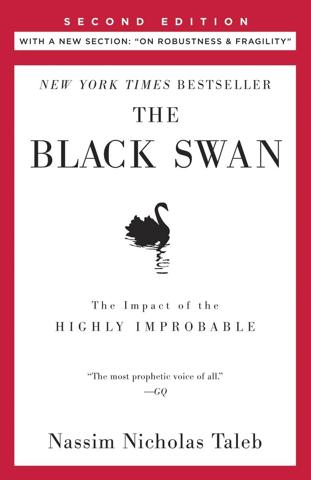
Critical Review of The Black Swan
The Impact of the Highly Improbable
By: Nassim Nicholas Taleb
The Black Swan by Nassim Nicholas Taleb is a widely influential book that argues that highly improbable events, which he terms "black swans," have a huge impact on the world and are often underestimated or rationalized after the fact. While the book has been praised for its insights, it has also faced several criticisms from the scientific and academic community.
One significant criticism of "The Black Swan" is its perceived conflation of different concepts and terminology. Taleb's use of the term "black swan" has been critiqued for being too broad and inclusive, sometimes conflating events that could have been expected but were merely rare, with those that were genuinely unforeseen. This lack of distinction can make it difficult to apply Taleb’s framework consistently across different domains. Some scientists and statisticians argue that by classifying too many events as black swans, the concept loses its analytical utility, limiting its applicability in practical risk management and decision-making contexts.
Another critique comes from statisticians who argue that Taleb underestimates the value of statistical tools and models. Taleb argues that many statistical methods, particularly those relying on Gaussian distribution, are ill-equipped to predict or accommodate black swan events. Critics, however, contend that while Taleb's skepticism of over-reliance on certain statistical models is valid, he dismisses their utility entirely. Many statisticians suggest that using more sophisticated models, such as fat-tailed distributions, can help better assess and manage the risks of rare events, though Taleb acknowledges these in his discussions.
Taleb’s tone and approach have also been critiqued, with some readers finding his style confrontational and dismissive of opposing viewpoints. Academics have pointed out that Taleb frequently critiques whole fields, such as economics and finance, for their failure to predict crises without thoroughly considering the nuanced approaches that already address these limitations. This approach can make it challenging to engage in constructive dialogue or build on his ideas within the academic community.
Finally, while Taleb emphasizes the unpredictability of extreme events, critics argue that he does not sufficiently explore solutions or strategies to cope with such unpredictability. The book is often perceived as more critical than constructive, with some readers expressing the need for a clearer framework or methodology for dealing with black swan events. While the work raises important questions about uncertainty and prediction, the emphasis on recognizing our limitations is sometimes seen as lacking in practical guidance for decision-making amidst uncertainty.
<< Back to the book summary