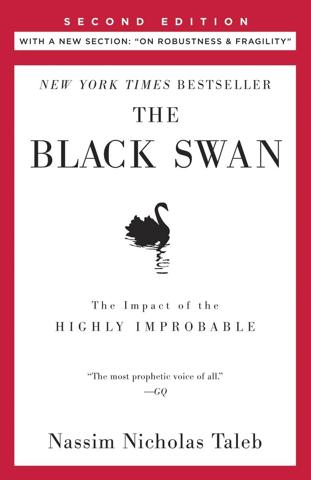
The Black Swan
The Impact of the Highly Improbable
By: Nassim Nicholas Taleb
Intro:
"The Black Swan: The Impact of the Highly Improbable," written by Nassim Nicholas Taleb, explores the profound impact of rare and unpredictable events, termed "Black Swans," on human life and society. In this enlightening book, Taleb challenges conventional wisdom by arguing that these unexpected events drive world history and personal experiences more than the routine does, yet remain overlooked by experts. Through a blend of philosophical insights and practical observations, Taleb underscores the limitations of our knowledge and the inevitability of uncertainty, urging readers to embrace volatility and be prepared for the unforeseen rather than relying on flawed predictions. This thought-provoking work encourages a reevaluation of how we perceive randomness and certainty, making it a seminal piece in understanding risk and decision-making in an unpredictable world.
The Black Swan by Nassim Nicholas Taleb is a philosophical and scientific treatise on the impact of rare and unpredictable events. Taleb argues that these events, which he refers to as "Black Swans," are largely responsible for shaping the course of history, science, finance, and technology.
Overview
The book is divided into several sections that illustrate Taleb's main thesis: that people are generally ill-equipped to predict or even recognize the occurrence of Black Swans, meaning that they often miscalculate risks when making decisions. Taleb combines philosophy, social science, and economics to support his arguments, using a mix of storytelling and analytical discourse.
Part One: Umberto Eco's Antilibrary, or How We Seek Validation
This section introduces the concept of the Black Swan and explains why people are often more concerned with what they know rather than the unknown. The metaphor of Umberto Eco's vast library, with its numerous unread books, demonstrates how we are more intrigued by our knowledge than by what we have yet to discover.
Part Two: We Just Can't Predict
In these chapters, Taleb delves into human nature's flaws in predicting future events. He discusses why experts and forecasts are often wrong and highlights the limitations of historical data and scientific formulas in predicting future occurrences. He critiques the "bell curve" and other statistical models as inadequate for addressing rare, unpredictable events.
Part Three: Those Grey Swans of Extremistan
Taleb differentiates between "Mediocristan" and "Extremistan"—two domains of randomness and risk. "Mediocristan" involves situations with constrained variability, where events follow a conventional distribution (like height and weight), while "Extremistan" involves events with massive impacts and unpredictable distributions (like wealth and book sales). Black Swans are products of Extremistan, where outliers have disproportionate effects.
Part Four: The Scandal of Prediction
This section critiques the prediction and risk management industries, criticizing the over-reliance on technologies and methods that fail to acknowledge the potential for Black Swan events. Taleb emphasizes the need for humility and skepticism, advocating for a more robust approach to dealing with uncertainty.
Part Five: Living with Black Swans
Taleb advises on how to "live with Black Swans" by developing resilience and embracing antifragility—the ability to thrive on chaos and randomness. He recommends strategies that minimize exposure to negative Black Swans while maximizing potential benefits from positive ones.
Key Concepts
- The Black Swan Problem: Surprise events that have major impacts and are often inappropriately rationalized with hindsight.
- Mediocristan vs. Extremistan: Different realms of predictability and randomness, influencing the scale of impact from outliers.
- The Ludic Fallacy: The misuse of theoretical models to predict complex real-world events.
- Antifragility: Becoming stronger and benefiting from volatility and uncertainty rather than merely resisting damage.
Conclusion
Nassim Nicholas Taleb's The Black Swan challenges conventional wisdom about risk and prediction, urging acceptance of uncertainty and embracing unpredictability's potential upsides. The book has widespread implications for decision-making across various fields, stressing the importance of being prepared for unforeseen events.