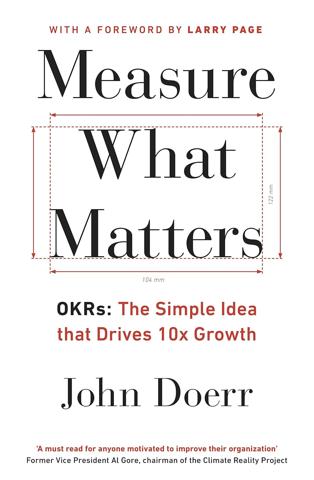
Critical Review of Measure What Matters
The Simple Idea that Drives 10x Growth
By: John Doerr
"Measure What Matters" by John Doerr is largely regarded as an influential business book that introduces the concept of Objectives and Key Results (OKRs), a goal-setting framework. However, despite its popularity and widespread adoption, the book and the OKR methodology have received some criticism from various quarters, which are worth discussing.
One major criticism is that the book tends to oversimplify the implementation of OKRs, making it seem like a straightforward, one-size-fits-all solution for any organization. Critics argue that adopting OKRs requires a cultural shift within the organization, which is often complex and challenging. The book provides inspirational stories and high-profile case studies from companies like Google and Intel, which may create an impression that success is easily replicable. However, these examples often do not convey the nuanced difficulties and failures behind adopting OKRs, thereby potentially setting unrealistic expectations.
Another point of critique is that "Measure What Matters" primarily focuses on quantitative metrics and may encourage a fixation on numbers at the expense of qualitative measures. Relying heavily on quantifiable results can sometimes lead companies to prioritize short-term gains over long-term strategic goals or to manipulate numbers to meet targets, thus undermining genuine progress and innovation. Critics suggest that while defining clear and measurable goals is important, the framework must also accommodate adaptable and quality-oriented approaches to truly drive growth.
Additionally, some scholars highlight that the book’s emphasis on OKRs can overshadow other aspects of strategic management and organizational behavior that are crucial for success. The methodology may not adequately address issues such as team dynamics, motivation, and the change management processes necessary for actual transformation. The book’s narrative doesn’t always present a balanced view of OKRs as part of a broader strategic framework, leaving some readers with a somewhat narrow perspective on goal setting and performance management.
Lastly, the book has been critiqued for relying heavily on anecdotal evidence and success stories rather than rigorous scientific research. While the case studies of companies like Google and Intel can be compelling, they may not universally apply to all types of organizations, particularly those in different industries or with different cultures and structural limitations. Without empirical validation across a wide range of contexts, some experts remain skeptical about whether OKRs can consistently deliver the massive growth suggested by the book.
<< Back to the book summary