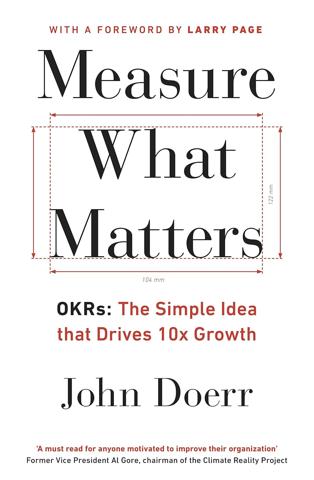
Measure What Matters
The Simple Idea that Drives 10x Growth
By: John Doerr
Intro:
"Measure What Matters: The Simple Idea that Drives 10x Growth" by John Doerr is a compelling exploration of the Objective and Key Results (OKRs) framework, a management approach that has been implemented by some of the most successful organizations in the world. The book elucidates how OKRs can serve as a powerful tool for driving a company’s growth by focusing on measurable outcomes. Doerr, who is a prominent venture capitalist and an early investor in Google, draws on his extensive experience to demonstrate how companies can set ambitious goals and consistently achieve them by aligning their teams around key objectives and measurable results. Throughout the book, Doerr shares in-depth case studies from industry giants like Google, Intel, and Bono’s ONE Campaign, showcasing how OKRs have helped them scale and succeed. He highlights how organizations can use OKRs to foster collaboration, accountability, and innovation by creating a transparent structure where every team member understands the organization's most important goals and their role in achieving them. The book also emphasizes the importance of focus and commitment, explaining how setting clear priorities can lead to exponential growth and success. Doerr’s narrative is enriched by insights from leaders and innovators who have successfully implemented OKRs, offering practical advice and actionable strategies for readers. "Measure What Matters" not only serves as a guide to understanding the OKR methodology but also inspires readers to adopt a mindset of continuous improvement and strategic focus. Through a combination of engaging storytelling and practical application, Doerr illustrates how organizations can unlock their potential and achieve extraordinary results by measuring what truly matters.
Overview: "Measure What Matters" by John Doerr is a comprehensive guide on implementing Objectives and Key Results (OKRs) in organizations. OKRs are a goal-setting framework designed to achieve focus, alignment, transparency, and accountability across teams and organizations. Doerr presents a compelling case for adopting OKRs, supported by real-world examples from companies like Google and Intel. The book is structured around detailed storytelling combined with practical advice, helping readers understand how to leverage OKRs to propel growth and innovation.
Introduction
John Doerr introduces the concept of OKRs through his own experience working with Andy Grove at Intel. Doerr emphasizes the transformational impact of OKRs in aligning organizations toward shared goals. He sets up the purpose of the book: to explore how OKRs can drive exceptional performance and growth.
Chapter 1: Google and OKRs
This chapter provides a detailed account of how Google embraced OKRs during its early years. Doerr recounts his meeting with Larry Page and Sergey Brin, where he introduced OKRs, and how those initial objectives helped Google maintain focus and scale rapidly. The chapter illustrates the flexibility and adaptability of OKRs in dynamic environments.
Chapter 2: Focus and Commitment to Priorities
In this chapter, Doerr underscores the importance of focus in achieving significant progress. He discusses how OKRs force organizations to prioritize their most critical goals and commit resources towards those objectives. The chapter includes examples of how companies have successfully implemented focused OKRs.
Chapter 3: Alignment and Teamwork
Doerr explores how OKRs promote alignment across different levels of an organization. They create a shared understanding of what teams are working towards and foster collaboration. He highlights stories from various industries where OKRs helped synchronize efforts across departments and teams.
Chapter 4: Tracking for Accountability
This chapter emphasizes the role of tracking and measuring progress in the OKR process. Doerr explains how regular check-ins and transparent tracking of key results ensure accountability, fostering a results-oriented culture. He provides practical tips for setting up effective tracking systems.
Chapter 5: Stretch for Amazing
Doerr introduces the concept of 'stretch goals', which are ambitious yet achievable targets that push organizations to innovate and excel. He discusses the psychology behind stretch goals and provides case studies where they have led to breakthroughs, encouraging a culture of bold aspirations.
Chapter 6: Superpower #1 — Focus and Commitment
This chapter revisits the power of focus and commitment, detailing how a disciplined approach to OKRs can lead to extraordinary outcomes. Doerr shares lessons from companies that have harnessed the full potential of this 'superpower'.
Chapter 7: Superpower #2 — Align and Connect
Here, Doerr delves deeper into the alignment capabilities of OKRs. The chapter illustrates how connected objectives throughout the organization ensure that everyone is moving in the same direction, enhancing synergy and reducing silos.
Chapter 8: Superpower #3 — Track for Accountability
This chapter focuses on the significance of rigorous tracking and performance reviews within the OKR framework. Regular assessment meetings, termed as "check-ins", are shown to be vital for maintaining accountability and making necessary adjustments.
Chapter 9: Superpower #4 — Stretch for Amazing
Doerr concludes the core concepts by reemphasizing the importance of setting challenging OKRs. He argues that setting high-reaching goals can drive organizations to their fullest potential, using Silicon Valley success stories as examples.
Case Studies
Throughout the book, Doerr includes numerous case studies from both big tech companies and lesser-known startups. These case studies provide real-world evidence of OKRs in action, demonstrating their versatility and impact in various contexts.
Conclusion
The book concludes with a reflection on the transformative power of OKRs for organizations of all sizes. Doerr reinforces the idea that OKRs are not just a management tool but a way to instill purpose and clarity in corporate culture.
Appendices
The appendices offer additional resources, templates, and advice for readers who wish to implement OKRs in their own organizations. This section serves as a practical toolkit for getting started with OKRs.