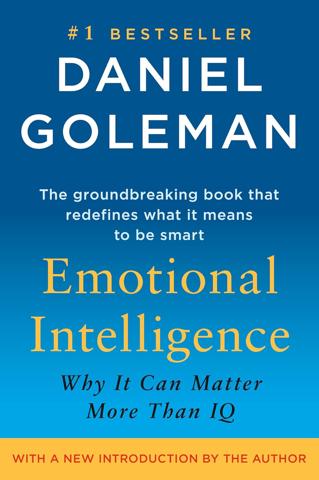
Critical Review of Emotional Intelligence
Why It Can Matter More Than IQ
By: Daniel Goleman
One of the major criticisms is that Goleman’s definition of emotional intelligence is overly broad and lacks precision. Unlike the original models proposed by Peter Salovey and John Mayer, which defined EI (Emotional Intelligence) as a set of cognitive abilities related to processing emotional information, Goleman expanded it to include motivation, persistence, and social skills. Critics argue that this makes EI indistinguishable from general personality traits or social competence, diluting its scientific usefulness. Psychologists like Jordan Peterson and researchers such as Antonakis et al. (2009) have argued that Goleman’s version of EI is more of a popular self-help concept than a rigorously defined psychological construct.
Another issue is the empirical evidence supporting the claims in Emotional Intelligence. Goleman asserts that EI is a stronger predictor of success than IQ, yet studies have shown mixed results. Some meta-analyses, such as those by Harms and Credé (2010), suggest that while EI correlates with job performance and leadership, traditional cognitive ability and personality traits (like conscientiousness) often have stronger predictive power. Critics argue that Goleman overstates EI’s role in success, creating a misleading narrative that downplays the importance of cognitive intelligence and technical skills.
Furthermore, the measurement of EI remains controversial. Goleman’s model relies heavily on self-report assessments, which are prone to social desirability bias and may not accurately reflect one’s actual emotional intelligence. Researchers like Landy (2005) have pointed out that many EI tests fail to demonstrate reliability and predictive validity in scientific studies. Unlike IQ, which has well-established measurement methods, EI’s measurement tools remain inconsistent, leading some to question whether it is a distinct, scientifically valid construct at all.
In summary, while Emotional Intelligence has contributed to public interest in emotional skills and their impact on life outcomes, it has also been criticized for its lack of scientific rigor, overstated claims, and conceptual vagueness. Many psychologists argue that while emotional intelligence exists, it is neither as revolutionary nor as crucial as Goleman suggests. Instead, they advocate for a more precise, research-based understanding of EI that aligns with established psychological principles.
<< Back to the book summary