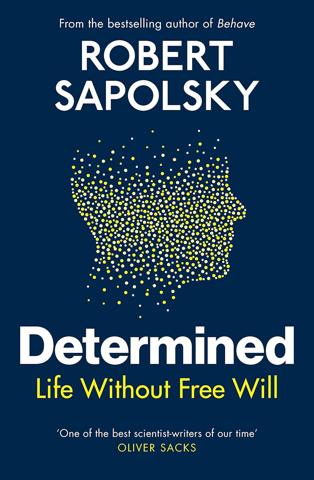
Determined
Life Without Free Will
By: Robert M. Sapolsky
Intro:
"Determined: Life Without Free Will" by Robert M. Sapolsky delves into the complex and often debated topic of free will, arguing against its existence with scientific rigor and philosophical inquiry. Sapolsky, a neuroscientist and primatologist, systematically explores how human behavior is governed by biology, genetics, and environmental factors rather than individual autonomy. He leverages insights from neuroscience, behavioral biology, and psychology to build a compelling case that our actions are determined by a complex set of interactions within our brains and bodies, influenced by both our genetics and the environment. Throughout the book, Sapolsky examines the implications of living in a world where free will is an illusion. He navigates through scenarios and moral conundrums that challenge our traditional notions of responsibility and justice. By arguing that every decision we make is the culmination of countless interconnected factors beyond our conscious control, Sapolsky raises questions about the fairness of our legal and moral systems. His approach is both scientific and empathetic, considering the broader social and ethical ramifications of this deterministic outlook. In "Determined," Sapolsky not only provides a thorough examination of the scientific evidence against free will but also engages with its philosophical and societal impacts. He seeks to redefine how we understand human nature and behavior, emphasizing the need for compassion in light of our lack of true agency. The book invites readers to rethink deeply held beliefs about autonomy, encouraging a shift towards understanding human actions through the lens of biological and environmental determinism.
In Determined: Life Without Free Will, Robert M. Sapolsky delves into the intricate and often debated concept of free will, asserting through scientific examination and philosophical discourse that free will is an illusion. He explores how our decisions and behaviors are the products of biological and environmental determinants, leading to the conclusion that our sense of making free choices is largely misguided.
Sapolsky begins by laying the groundwork of his argument with a thorough investigation into neuroscience, focusing on how our brains function in ways that are governed by genetics, brain chemistry, and the myriad external factors that influence our development. He explains complex topics such as the role of neurotransmitters, the impact of upbringing and environment, and the influence of subconscious processes on conscious decision-making. Through these discussions, he slowly dispels the commonly held notion that humans act with autonomous free will.
The book progresses by exploring the implications of a life without free will, both on personal and societal levels. Sapolsky examines ethical dilemmas, the justice system, and moral responsibility, questioning how societies can maintain order and justice if individual accountability is considered a myth. These sections challenge readers to reconsider deep-seated concepts of blame and punishment in light of new understanding.
To support his arguments, Sapolsky includes a wide array of research from various disciplines, creating an interdisciplinary approach to dissecting free will. He draws from fields including psychology, biology, sociology, and philosophy, synthesizing diverse perspectives to strengthen his thesis. His inclusive methodology not only bolsters his arguments but also encourages readers from all backgrounds to engage with the content critically.
Throughout the book, Sapolsky maintains an approachable yet rigorous tone, aiming to make complex theories accessible to his audience. His use of anecdotes, analogies, and humor complements the scientific discourse, ensuring that readers remain engaged with the material. This stylistic approach helps demystify daunting scientific concepts while fostering a space for readers to ponder the broader implications of a deterministic outlook on life.
In conclusion, "Determined: Life Without Free Will" serves as both an enlightening and provocative examination of the concept of free will. By deconstructing the illusion of free will through scientific exploration and philosophical inquiry, Sapolsky leaves readers with profound questions about human nature, agency, and the structure of society. His work challenges long-held beliefs and encourages a reevaluation of how we perceive our actions and the world around us. This book is a significant contribution to ongoing discussions about human behavior, morality, and the essence of human choice.