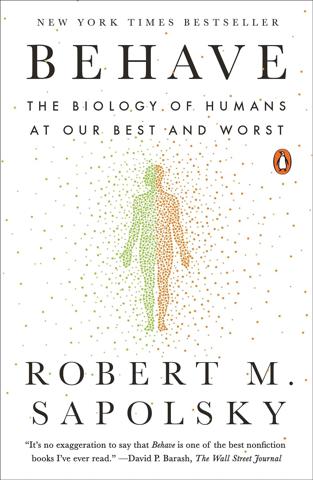
Behave
The Biology of Humans at Our Best and Worst
By: Robert M. Sapolsky
Intro:
"Behave: The Biology of Humans at Our Best and Worst" by Robert M. Sapolsky is a compelling exploration of the myriad factors that influence human behavior. Sapolsky, a renowned neuroscientist and biologist, delves into the complex interplay of biology, environment, and psychology to unravel the mysteries of why humans act the way they do. The book begins with the minutiae of what happens in our brains in the moments before a behavior occurs, gradually moving backward through time to consider the genetic, hormonal, and cultural influences that shape our actions. By marrying insights from neuroscience with those from fields such as endocrinology, anthropology, and psychology, Sapolsky provides a nuanced view that challenges simplistic explanations of behavior.
Throughout the book, Sapolsky emphasizes the importance of context. He persuasively argues that understanding behavior requires considering not only what is happening in the immediate present but also the layers of past experiences that mold our responses. This approach enables Sapolsky to address complex questions about violence, morality, empathy, and cooperation. Why might someone react with aggression in one situation but show compassion in another? Sapolsky suggests that answers lie not just in the brain's neural circuits but also in the social and cultural frameworks within which individuals operate.
With wit and intellectual rigor, Sapolsky provides a thought-provoking narrative that engages both scientific minds and general readers. His storytelling weaves scientific detail with real-world examples, making complex scientific concepts accessible without diminishing their depth. "Behave" is not just an exploration of human behavior; it is a call to understand the human condition more empathetically, recognizing the biological and environmental factors that influence our best and worst actions. In doing so, Sapolsky provides tools for fostering compassion and improving the ways we interact with one another.
Introduction
The book "Behave: The Biology of Humans at Our Best and Worst" by Robert M. Sapolsky provides an extensive exploration of human behavior from a neuroscientific perspective. Sapolsky aims to dissect the complex interplay between biology and behavior and how various factors from neurobiology and genetics to evolution and culture contribute to human actions.
Chapter 1: The Behavior
The opening chapter sets the stage by digging into the immediate causes of behavior, examining the brain processes that occur seconds before an action. Sapolsky explains how different regions of the brain, like the prefrontal cortex, are involved in decision-making and impulse control. This chapter highlights the role of neural signaling and neurotransmitters in prompting immediate reactions.
Through case studies and examples, Sapolsky elucidates the complexity and diversity of factors that can influence behavior in the short term. This introduction into the biological underpinnings of behavior aims to instills a deeper understanding of the immediacy of brain processes in influencing human actions.
Chapter 2: One Second Before
Shifting focus, Sapolsky looks at what happens seconds to minutes before behavior takes place. Topics such as sensory inputs, processing of stimuli, and emotional responses are explored. He describes the influence of hormones and neurochemicals that act on the brain over these brief timescales.
Sapolsky emphasizes how subtle changes in the brain's environment, such as the presence of certain hormones like adrenaline, can rapidly shape responses. The chapter delves into the roles of different neurotransmitters such as dopamine and serotonin, showcasing their significant impact on emotions and decision-making in a short timespan before actions occur.
Chapter 3: Hours to Days Before
This chapter examines the biological and environmental processes occurring hours to days before behavior manifests. Sapolsky discusses the impact of circadian rhythms, sleep cycles, and the endocrine system's fluctuations on behavior and mental states during this period.
The narrative covers how stress hormones can affect behavior in this intermediate timeframe. The chapter also explores how recent experiences and time-of-day influences can alter predispositions towards certain behaviors, highlighting the complex relationship between external conditions and internal biological states.
Chapter 4: Adolescence, Childhood, and the Fetal Environment
Sapolsky explores how early life experiences, dating back to fetal development, can shape the brain and behavior in the long term. He examines how adolescence, as a critical period of brain development, contributes to lifelong behavioral tendencies.
The chapter details how factors such as prenatal influences, childhood environment, and adolescent brain reorganization play essential roles in future behavior. Sapolsky also addresses issues of neuroplasticity and the lasting impact of early life stress on behavioral outcomes.
Chapter 5: Centuries to Millennia Before
In this chapter, Sapolsky addresses evolutionary biology and the role of genetics in shaping human behavior over millennia. He articulates how natural selection has influenced the development of behaviors aimed at survival and reproduction.
The author assesses various human traits and their evolutionary advantages, offering insight into why certain behaviors might persist across generations. This broader timescale brings a long-term perspective to understanding behavior, examining how deep evolutionary roots can impact contemporary actions.
Chapter 6: The Biology of Violence, Aggression, and Competition
Focusing on negative aspects of behavior, Sapolsky evaluates aggression and violence from a biological standpoint. He dissects the myriad factors that drive competitive and aggressive behaviors, from neurobiology to social and environmental influences.
Sapolsky provides a nuanced view, arguing that while biology has a significant role, it is not determinant. He highlights the significant impact of socialization, cultural norms, and individual differences in shaping one's propensity towards violence and aggression.
Chapter 7: Biology, the Criminal Justice System, and the Free Will Problem
Sapolsky delves into the intersection of biology and society, exploring how our understanding of behavior influences the criminal justice system. He challenges conventional notions of free will by discussing how biological systems constrain decision-making.
The chapter brings to light ethical considerations and implications for policy-making, emphasizing the need for a justice system that recognizes the complexity of human behavior. Sapolsky advocates for a more informed and compassionate approach to crime and punishment.
Chapter 8: The Evolution of Behavior and the Myth of Pure Evil
The author scrutinizes the concept of evil, dissecting how evolutionary biology can help decipher behaviors that are often labeled as malicious or immoral. He argues that what is often considered "evil" can be explained by a network of evolutionary, social, and biological influences.
Sapolsky attempts to dismantle the myth of pure evil by highlighting the nuanced array of factors that contribute to harmful behaviors. This exploration aims to draw empathy and understanding for actions traditionally deemed inherently bad, by framing them within a context of multifaceted influences.
Conclusion: Human Behavior at Its Best and Worst
Sapolsky concludes by bringing together previous discussions, acknowledging the profound complexity involved in human behavior. He advocates for a multi-disciplinary approach to understanding actions, combining insights from biology, psychology, and social sciences.
The author leaves readers with a sense of cautious optimism, suggesting that deeper understanding can foster better ways to manage human behavior, encouraging good and mitigating bad. He emphasizes the power of informed change and the need for societies to integrate this knowledge in fostering more harmonious and empathetic interactions among individuals.
Overall Summary
"Behave: The Biology of Humans at Our Best and Worst" is a comprehensive investigation into the myriad influences on human behavior, brilliantly intersecting biology with psychology and sociology. Robert Sapolsky articulates how actions come to be from moments before they occur to centuries of evolutionary adaptation, providing a rich narrative that navigates through different timescales to unveil the intricate determinants of behavior.
The book encourages readers to rethink traditional notions of morality, free will, and the nature of humans, advocating for a nuanced view that incorporates deep biological insights with social understanding. Sapolsky leaves the reader with not only a deeper comprehension of human actions but also a call to apply this knowledge thoughtfully to foster a better society.