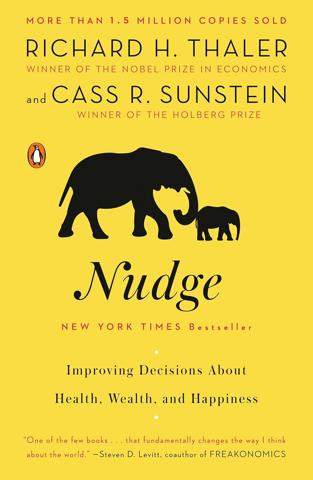
Nudge
Improving Decisions About Health, Wealth, and Happiness
By: Richard H. Thaler, Cass R. Sunstein
Intro:
"Nudge: Improving Decisions About Health, Wealth, and Happiness" by Richard H. Thaler and Cass R. Sunstein explores the concept of "libertarian paternalism," where individuals are guided to make better decisions through subtle nudges while maintaining their freedom of choice. The authors illustrate how thoughtful design of choice architecture can improve various aspects of life, including healthcare, personal finance, and overall well-being, by harnessing behavioral economic principles. Through engaging examples and rigorous research, Thaler and Sunstein demonstrate how small changes in how choices are presented can lead to significant improvements in outcomes, empowering readers to optimize decision-making for themselves and society.
Introduction
Nudge: Improving Decisions About Health, Wealth, and Happiness is a groundbreaking book by Richard H. Thaler and Cass R. Sunstein that explores how concepts from behavioral economics can be used to improve decision-making. The book introduces the concept of libertarian paternalism, which suggests that it is both possible and legitimate for private and public institutions to affect behavior while also respecting freedom of choice. The authors argue that by understanding how people think, we can use sensible "nudges" to guide people towards better decisions.
The book is structured around the central idea that humans often make poor choices due to cognitive biases and that these choices can be improved with simple interventions. These interventions, or "nudges," help people make decisions that align with their interests without restricting their freedom. Thaler and Sunstein examine various areas of life, such as health, finance, and personal happiness, where nudges can be effectively applied.
Chapter 1: Biases and Blunders
In the first chapter, Thaler and Sunstein introduce some basic concepts from behavioral economics, particularly focusing on the common cognitive biases and errors that lead people to make suboptimal decisions. They discuss how people often rely on heuristics or rules of thumb that can lead to systematic errors. These include biases like anchoring, where individuals heavily rely on the first piece of information they receive, or the status quo bias, where people prefer things to stay the same by opting for default options.
The authors argue that these cognitive limitations can be exploited in ways that harm us, but they can also be corrected through appropriately designed choice architectures. By designing environments that account for these tendencies, we can help people make decisions that better align with their intentions and improve their well-being.
Chapter 2: Resisting Temptation
This chapter delves into the human struggle with self-control and how it impacts decision-making. Thaler and Sunstein describe how individuals often make choices that satisfy immediate desires at the expense of long-term well-being. The authors discuss the concept of "hyperbolic discounting," which explains why people often procrastinate and make impulsive decisions.
The chapter presents nudging strategies that can help bridge the gap between a person’s present impulses and their long-term goals. This includes automatically enrolling employees in pension plans with an option to opt-out, thus leveraging the tendency to stick with default decisions for positive outcomes.
Chapter 3: Following the Herd
Thaler and Sunstein examine the influence of social norms on individual behavior in this chapter. They highlight how people often look to others for cues on how to behave, which can lead to herd behavior. While this reliance on social information can be beneficial, it can also lead to negative behaviors if the herd is making poor choices.
Through examples such as energy consumption, the authors demonstrate how providing individuals with information about how their behavior compares to their peers can nudge them towards more socially beneficial choices. By using descriptive norms, policymakers can subtly guide behavior in positive directions without heavy-handed interventions.
Chapter 4: When Do We Need a Nudge?
This chapter explores the circumstances under which nudges are most needed and effective. Thaler and Sunstein discuss situations characterized by complexity, infrequency, and lack of feedback, where people are more likely to make poor decisions. Examples include choosing healthcare plans or saving for retirement.
The authors emphasize the importance of recognizing when individuals would benefit from a nudge, suggesting that nudges are especially useful when stakes are high and decisions are difficult to reverse. They advocate for designing choice architectures that help individuals navigate these challenging decisions more effectively.
Chapter 5: Choice Architecture
In this chapter, the authors introduce the concept of choice architecture, which refers to the way choices are presented to individuals. By designing environments where beneficial choices are easier to make, decision-makers can help individuals achieve more desirable outcomes.
Thaler and Sunstein describe various tools and strategies for effective choice architecture, such as setting optimal defaults, structuring complex choices in a simplified manner, and leveraging cues to influence decisions. They stress the importance of transparency and maintaining the individual's right to choose.
Chapter 6: Saving the Planet
Thaler and Sunstein use this chapter to discuss how nudges can be instrumental in addressing environmental challenges. They examine how small changes in individual behavior can lead to significant positive impacts on the environment.
By presenting ideas like eco-labeling, default green energy plans, and information campaigns, they illustrate potential strategies to encourage sustainable practices among individuals and corporations. Through nudging, collective action problems like climate change can be partially addressed by changing individual behavior at scale.
Chapter 7: Objections
Addressing potential criticisms, Thaler and Sunstein engage with concerns surrounding paternalism and autonomy. They recognize that there is a debate about the ethical implications of influencing people's choices, even if it is for their own benefit.
The authors argue that nudging does not restrict freedom but merely leverages existing biases in ways that promote welfare. They discuss the importance of ensuring that nudges are transparent, democratic, and designed with the well-being of individuals in mind.
Conclusion
In the conclusion, Thaler and Sunstein emphasize the practical and positive potential of nudging when applied ethically and responsibly. They envision a world where individuals are aided in making better choices across various domains, leading to improved personal and societal outcomes.
Through "Nudge," the authors inspire policymakers, businesses, and individuals to rethink traditional approaches to decision-making, advocating for environments that support rather than undermine human well-being. This book encourages a re-examination of how small, thoughtful interventions can lead to substantial improvements in people’s lives.