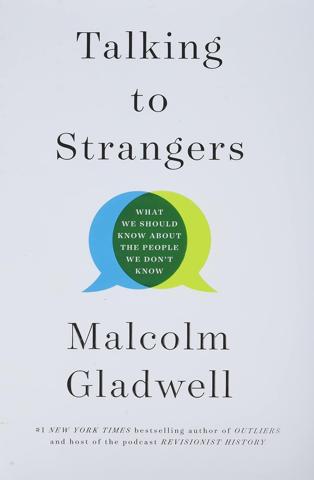
Talking to Strangers
What We Should Know about the People We Don't Know
By: Malcolm Gladwell
Intro:
"Talking to Strangers" by Malcolm Gladwell is an engaging exploration of the complexities and misunderstandings that arise when we interact with people we don’t know. Gladwell delves into historical and contemporary cases, ranging from criminal investigations to diplomatic encounters, to illustrate how our assumptions and biases can lead to dramatic failures in communication. Through a blend of storytelling and insightful analysis, he challenges readers to reconsider their perceptions of trust and the ways we interpret the behavior of strangers, ultimately prompting a deeper reflection on human interaction and societal norms.
Introduction
In the introduction, Gladwell sets the stage for exploring the misunderstandings that can occur when we engage with strangers. He uses the case of Sandra Bland to highlight how interactions can escalate when strangers misread each other's intentions.
Chapter 1: Fidel Castro's Revenge
This chapter discusses how Cuban spies fooled U.S. intelligence for years. Gladwell introduces the concept of "default to truth," which suggests that humans tend to believe others unless given a compelling reason not to.
Chapter 2: The Queen of Cuba
Gladwell examines the case of Ana Montes, a Cuban spy in the US government. This underscores how easily people are deceived due to their bias toward truth. Montes operated under the radar because people assumed her integrity.
Chapter 3: We Should Have Known
This chapter discusses the notorious case of Bernie Madoff, a Ponzi schemer. Gladwell illustrates how his consistent deception fooled countless investors, reflecting the consequences of our truth-default tendency.
Chapter 4: The Holy Fool
Gladwell introduces "holy fools" – individuals who challenge the norm and bring to light questionable behavior. He uses the story of Harry Markopolos, who tried to expose Madoff's scheme but was ignored, highlighting how we often dismiss dissenters.
Chapter 5: The Boy in the Shower
This chapter investigates the Jerry Sandusky scandal and why people failed to perceive his crimes. Gladwell demonstrates the complexities involved in accusations when they come from strangers or unexpected sources.
Chapter 6: Transparency
Gladwell questions the assumption of transparency—that people's feelings and thoughts are evident in their behavior. He uses examples like Amanda Knox's case to show how misleading appearances can be.
Chapter 7: The Friends Fallacy
In this chapter, Gladwell examines how visual cues can be misleading. Using the example of the television show "Friends," he explains that we often rely on overt signs to judge emotions, which do not always reflect true feelings.
Chapter 8: A (Short) Explanation of Human Error
This chapter delves into the errors humans make while judging strangers, focusing on defaulting to truth and the misinterpretation of signs. Gladwell discusses how these can lead to significant failures in understanding.
Chapter 9: Sylvia Plath
Gladwell explores the broader cultural and social factors that contribute to misunderstandings, looking at the example of Sylvia Plath’s suicide. He argues that societal context plays a crucial role in personal interactions.
Chapter 10: Coupling
This chapter introduces the concept of coupling, explaining how behavior is linked to specific circumstances or contexts. Gladwell uses the example of suicide and crime rates to show that place and situation matter significantly.
Conclusion: Sandra Bland
In concluding, Gladwell revisits the Sandra Bland case to emphasize his overarching message: misunderstandings with strangers often have serious, even tragic, consequences. He encourages readers to embrace complexity in interactions.
Afterword
In the afterword, Gladwell reflects on the book’s themes and the need for better understanding and communication with strangers. By considering factors like context, transparency, and our biases, we can improve our interactions.