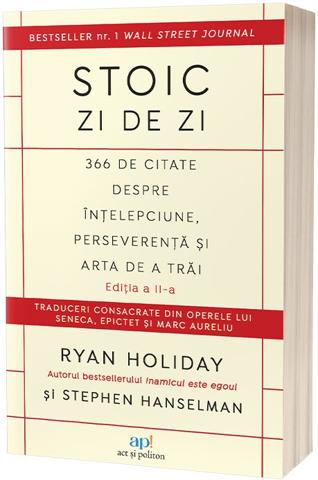
O revizie critică a cărții The Daily Stoic
366 Meditations on Wisdom, Perseverance, and the Art of Living
De: Ryan Holiday, Stephen Hanselman
The book The Daily Stoic: 366 Meditations on Wisdom, Perseverance, and the Art of Living by Ryan Holiday and Stephen Hanselman has been generally well-received for its accessible introduction to Stoic philosophy, breaking down ancient wisdom into digestible daily reflections. However, one criticism that arises from some scholars and readers is the oversimplification inherent in distilling complex philosophical ideas into brief daily entries. Stoicism, as a rich and extensive philosophical tradition, involves nuanced arguments and contexts that might be lost in a format designed for quick daily consumption. This simplification can lead to a misunderstanding or superficial engagement with Stoic teachings, which require deep contemplation and understanding to grasp fully.
Another criticism pertains to the authors' reliance on historical texts and figures, sometimes without adequate contextualization. While "The Daily Stoic" quotes figures such as Marcus Aurelius, Seneca, and Epictetus, it does so selectively and often in ways that prioritize modern interpretations over historical accuracy. Critics argue that this approach can inadvertently misrepresent the original intentions or contexts of these ancient philosophers. Without sufficient context, readers might form misinformed views about what Stoicism truly advocates, which may differ from how these ideas were interpreted in ancient times.
Furthermore, some scholars argue that there is an inherent tension in the commercialization of Stoic philosophy as portrayed in this and similar modern works. The current trend of applying ancient philosophies like Stoicism to modern self-help frameworks can sometimes dilute their original messages. By packaging Stoicism into a daily meditation cycle aimed at personal development, there is a risk of transforming it into a kind of "pop philosophy," which might not honor the more demanding ethical and metaphysical dimensions of the originals. This presenting Stoicism more as a series of life hacks rather than a comprehensive worldview or moral and ethical system is a point of contention among purists.
Additionally, the book’s focus on individual empowerment and resilience reflects modern self-help narratives, which may sometimes diverge from the communal and duty-bound aspects of traditional Stoicism. Stoic philosophy emphasizes harmony with nature, acceptance of fate, and living in accordance with virtue, often within a social and communal context. By emphasizing personal achievement and productivity, "The Daily Stoic" might overshadow these aspects in favor of a more individualistic interpretation, appealing to contemporary readers but cutting away communal responsibilities and the fuller moral discourse Stoics originally engaged with.
In summary, while "The Daily Stoic" offers an engaging entry point into Stoic philosophy for many, the concerns regarding its approach highlight the complexities in translating ancient philosophy for modern audiences. It raises important considerations about the balance between accessibility and depth, historical accuracy and modern relevance, as well as the potential consequences of transforming philosophical teachings into marketable self-help products. These critiques invite readers to delve deeper into Stoicism beyond just the daily meditations to more fully appreciate its profound insights and applications.
<< Înapoi la rezumatul cărții