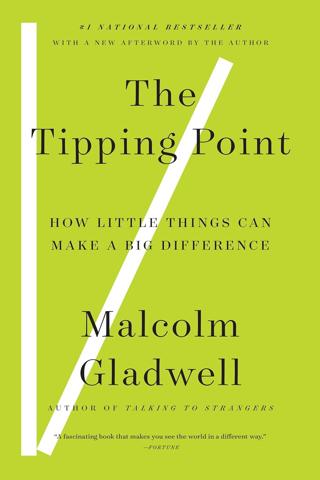
O revizie critică a cărții The Tipping Point
How Little Things Can Make a Big Difference
De: Malcolm Gladwell
"The Tipping Point: How Little Things Can Make a Big Difference" by Malcolm Gladwell, published in 2000, has been both celebrated for its engaging storytelling and critiqued for its scientific rigor. The book explores the idea that small actions at the right time, in the right context, and with the right people can create a "tipping point," leading to significant change. While Gladwell's work has popular appeal, it has faced criticism from some scientists and academics who question the methodological robustness and conceptual underpinnings of his thesis.
One major critique of "The Tipping Point" is that it oversimplifies complex social phenomena. Critics argue that Gladwell's focus on a few key case studies and examples tends to ignore the broader, systemic factors that contribute to social change. For instance, he describes how the spread of ideas and behaviors can be likened to epidemics, but this analogy has limitations. Critics assert that real-world social changes are influenced by a multitude of variables, and isolating a few as particularly transformative, without rigorous empirical analysis, overlooks the complexity of social networks and dynamics.
Another scientific criticism is related to the lack of empirical evidence supporting some of Gladwell's claims. The concept of "The Law of the Few," which suggests that a few well-connected individuals in a network, such as 'Connectors', 'Mavens', and 'Salesmen', have disproportionate impact in spreading ideas, has been contested. Researchers have pointed out that while individuals with extensive networks can help disseminate information, the impact of such dissemination is often contingent on broader societal conditions, and not just the individuals themselves. Studies in network theory and sociology have highlighted that influence is more distributed and less predictable than Gladwell's examples might suggest.
Moreover, Gladwell's reliance on anecdotal evidence is another point of contention. Critics argue that "The Tipping Point" often cherry-picks instances where tipping points were seemingly pivotal, thus presenting a somewhat deterministic view of the social world. This approach can result in selective bias, where only supporting evidence is highlighted, overlooking cases that do not fit the narrative. Critics advocate for a more robust scientific methodology, where hypotheses are systematically tested across multiple contexts and variables are controlled for, to establish a clearer causal relationship.
Despite these criticisms, it's worth noting that Gladwell’s work has also been praised for sparking interest in the study of social dynamics and bringing complex theories into the public discourse in an accessible manner. His storytelling prowess has made complicated concepts about social behavior and influence more understandable to a broader audience. However, these strengths do not negate the need for careful consideration and critical evaluation of the scientific basis of his claims, especially when translating intricate social science research into general principles. This balance between narrative appeal and scientific rigor remains a central discussion point in evaluating the contributions and limitations of "The Tipping Point."
<< Înapoi la rezumatul cărții