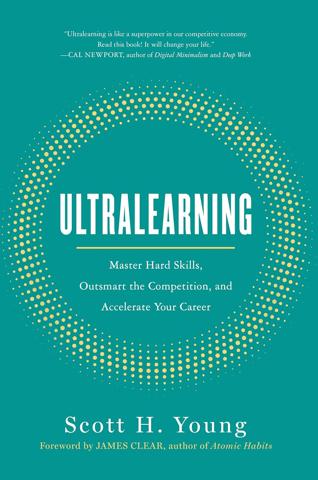
Ultralearning
Master Hard Skills, Outsmart the Competition, and Accelerate Your Career
De: Scott Young
Introducere:
Ultralearning: Master Hard Skills, Outsmart the Competition, and Accelerate Your Career by Scott Young is a powerful guide that delves into unconventional strategies and robust techniques for self-directed learning. In this compelling book, Young explores the concept of “ultralearning,” which he defines as a strategy for aggressive, self-directed learning that can help individuals rapidly acquire new skills and knowledge. Whether it's for career advancement, personal growth, or sheer intellectual curiosity, Ultralearning provides insights into how one can become a more effective learner. Young draws from a wealth of scientific research on cognitive psychology and real-life examples of successful ultralearners, thereby weaving a narrative that is both informative and inspiring. Throughout the book, Young articulates nine core principles of ultralearning, including intense focus, retrieval, directness, and feedback. These principles are designed to guide readers in constructing their own learning projects that are both efficient and effective. The author emphasizes the importance of understanding how learning truly works, debunking common myths about learning processes, and encouraging readers to embrace a mindset of continuous improvement and curiosity. Young's writing not only explains the theoretical aspects of learning but also offers practical advice and strategies that can be applied to a wide range of disciplines—from mastering a new language to advancing in a technical field. In "Ultralearning," Scott H. Young also shares his personal journey and stories of others who have successfully adopted ultralearning methods, illustrating how devoted individuals can dramatically change their lives through intense, self-motivated education. By challenging conventional educational paradigms, Young promotes a new way of thinking about and engaging with the learning process. This book is particularly beneficial for those looking to gain a competitive edge in careers where adapting to new challenges quickly is crucial. Overall, *Ultralearning* serves not only as a motivational read but also as a practical toolkit for anyone eager to move beyond traditional learning methods to achieve exceptional results.
Introduction
Ultralearning by Scott H. Young introduces readers to the concept of "ultralearning," a strategy for acquiring skills and knowledge rapidly and effectively. The author shares the secrets behind several ambitious "ultralearning" projects, including his own experiences and those of others who have successfully employed these principles to master complex fields in record time.
Chapter 1: Understanding Ultralearning
This chapter sets the stage by defining what ultralearning is and why it's an invaluable tool for personal and professional growth. Young elucidates the nine principles of ultralearning, explaining how these can be harnessed individually or collectively to learn anything faster and more efficiently than traditional educational methods. He recounts several success stories, including his own journey of completing MIT’s four-year computer science curriculum independently in just one year.
The chapter also discusses the innate human potential for learning and personal growth, challenging the conventional educational paths and emphasizing the importance of crafting a self-directed learning journey. Young positions ultralearning as a power skill in the modern economy, where adaptability and quick learning have become paramount.
Chapter 2: The Principles of Ultralearning
Young delves deeper into each of the nine ultralearning principles, providing a framework to approach learning systematically. He includes principles like “Metalearning,” which involves understanding how you learn best, and “Focus,” emphasizing the necessity of concentrated, undistracted effort. Each principle is dissected to show how it can be applied strategically across different domains of knowledge or skills.
The author augments these principles with real-world examples from ultralearning projects, demonstrating how they can be practically implemented. Through stories of acquiring new languages, mastering artistic skills, and technical expertise, Young illustrates how ultralearning can break down the barriers of traditional learning environments.
Chapter 3: Metalearning - Draw a Map
The first principle of ultralearning is "Metalearning," or learning about how you learn. This chapter guides readers to map out the territory of their learning project before diving in. Young suggests breaking down a subject into its component parts, examining how the experts in the field have mastered it, and identifying the most effective resources and tools available.
Young emphasizes the importance of understanding personal learning strengths and weaknesses. By selecting appropriate resources and approaches, learners can customize their ultralearning projects for maximum effectiveness. This chapter lays the groundwork for effective personal education strategies, tailored for individuals rather than one-size-fits-all solutions.
Chapter 4: Focus - Sharpen Your Knife
In this chapter, Young discusses the importance of focus in the ultralearning process. He explores common distractions and productivity pitfalls in modern society, presenting methods for carving out uninterrupted time for deep work and concentrated study. Practical techniques like time-boxing and digital detox are introduced to help maintain unwavering focus.
Young argues that focused learning sessions catalyze understanding and retention of complex material. By dedicating time to intensely focused study, ultralearners can achieve in a short period what might take others significantly longer, underlining the efficiency of focused mental application.
Chapter 5: Directness - Go Straight Ahead
The principle of "Directness" supports the idea of learning through doing. This chapter asserts that the best learning experiences come from direct interaction with the real world context of a skill. Young encourages a pragmatic application of learning, such as practicing a language by conversing with native speakers rather than solely using software applications.
Young underscores that achieving mastery often requires stepping out of comfort zones and diving into real-world practice scenarios. By applying knowledge directly, learners reinforce what they've studied and adapt it to practical use, fostering quicker assimilation.
Chapter 6: Drill - Attack Your Weakest Point
The "Drill" principle advocates for targeted practice on weak points within a skill or knowledge domain. Young provides compelling examples of successful ultralearners who have honed their skills through deliberate, focused practice on their weakest areas to rapidly elevate their overall competence.
The chapter discusses methods for identifying weaknesses and devising drills that specifically aim to convert these weaknesses into strengths. By strategically refining their skill set, ultralearners can overcome obstacles and boost proficiency far more rapidly than casual, generalized practice would allow.
Chapter 7: Retrieval - Test to Learn
"Retrieval" emphasizes the importance of active recall and testing oneself on the material learned. Young explains that passive review of notes or rereading texts is less effective than actively using the information to resolve problems or engage in self-testing.
The author provides techniques for integrating retrieval practice into ultralearning projects. By encouraging regular, rigorous self-testing, learners can reinforce their memory, identify gaps in knowledge, and systematically track their progress toward mastery.
Chapter 8: Feedback - Don't Dodge the Punches
Feedback is vital to any learning process, and this chapter addresses effective ways to solicit and process feedback. Young presents strategies to not only be open to receiving feedback but to actively seek it, even if it is uncomfortable or critical.
Through case studies, the chapter illustrates how constructive feedback is invaluable for refining skills and understanding areas needing improvement. The learners who are adept at leveraging feedback can steer their projects in more productive directions, continually refining their approach until they achieve mastery.
Chapter 9: Retention - Don't Fill a Leaky Bucket
In this chapter, Young explores how to ensure that knowledge and skills learned are retained over the long term. Retention is critical as skills and knowledge that aren't used can fade quickly. The author discusses practical techniques to improve long-term retention, such as spaced repetition and varied practice.
Young highlights that a pragmatic retention strategy is essential for ultralearners aiming for deep mastery. He shares insights on integrating learned material regularly and diversifying practice techniques to enhance retention, thus solidifying foundational knowledge that supports future learning endeavors.
Chapter 10: Intuition - Dig Deep Before Building Up
Developing intuition involves deepening understanding and insight rather than surface-level learning. Young explains that cultivating intuition in a subject allows learners to navigate complexity and solve problems more creatively.
This chapter suggests methods for fostering intuition, such as connecting new knowledge with existing cognitive frameworks and revisiting material frequently to deepen understanding. Young argues that building a strong intuitive grasp of a subject sets the stage for innovation and flexibility in its application.
Chapter 11: Experimentation - Explore Outside Your Comfort Zone
The final principle, "Experimentation," champions the idea of trying new methods and pushing the boundaries of one’s current capabilities. Young encourages ultralearners to explore novel learning techniques and approaches to overcome deadlocks and stimulate creativity.
This chapter is a call to embrace trial-and-error as a learning tool. By experimenting with untested methods, ultralearners can discover unique pathways and insights, fostering an adaptive mindset that serves them well in rapidly changing environments.
Conclusion
In concluding the book, Young offers a robust roadmap for personal and professional development through ultralearning. The combination of principles outlined provides a comprehensive guide for readers eager to accelerate their learning trajectory and enhance their capabilities. Ultralearning is posited not just as a skill but as a lifestyle choice, encouraging perpetual growth and adaptation in an ever-evolving world.
Young’s narrative, supported by thorough research and compelling anecdotes, makes a convincing case for those willing to take charge of their education and career by mastering ultralearning. This book is a valuable resource for anyone looking to distinguish themselves professionally or pursue personal learning goals with ambition and rigor.