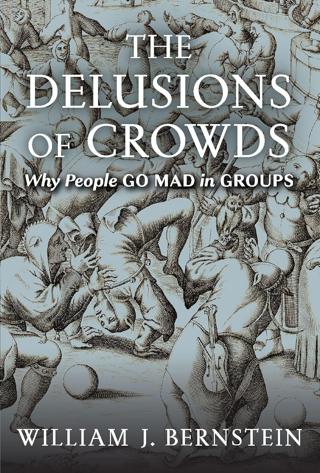
Reseña Crítica de The Delusions of Crowds
Why People Go Mad in Groups
De: William J. Bernstein
"The Delusions of Crowds: Why People Go Mad in Groups" by William J. Bernstein offers an exploration of mass delusions, spanning financial bubbles and religious fervor. While the book has garnered praise for its engaging storytelling and historical analysis, some criticisms have emerged from a scientific standpoint.
One critique is centered around the book's reliance on historical anecdotes over rigorous scientific analysis. Although Bernstein draws on a wealth of historical events to illustrate his thesis, some argue that the book does not delve deeply enough into the psychological mechanisms behind groupthink and mass hysteria. Critics suggest that integrating more contemporary psychological and sociological theories could have provided a stronger foundation for understanding why crowds behave irrationally.
Another point of criticism is the book's generalization of complex events. By juxtaposing financial bubbles with religious movements, Bernstein creates a broad narrative that some reviewers feel oversimplifies diverse phenomena. While the comparison of different forms of mass delusion is intriguing, critics argue that the factors driving economic bubbles can be qualitatively different from the forces behind religious zeal, requiring distinct analyses.
Additionally, some reviewers have noted that while "The Delusions of Crowds" is rich with historical detail, the book occasionally lacks depth in its exploration of the individual psychological factors contributing to group delusions. The focus is heavily placed on the group's behavior, potentially overlooking the role of personal psychology and the diversity of individual experiences within mass movements. This has led to calls for a more nuanced discussion of the interplay between individual cognition and group dynamics.
Lastly, while the historical context is a strength, some scientific critics argue that the book could benefit from incorporating more empirical data and cross-disciplinary research. By leaning heavily on historical narratives, Bernstein may miss opportunities to connect these past events with contemporary scientific understanding of human behavior, such as insights from neuroscience or behavioral economics. This integration could provide a more robust explanation for the enduring nature of crowd-induced delusions.
<< Volver al resumen del libro