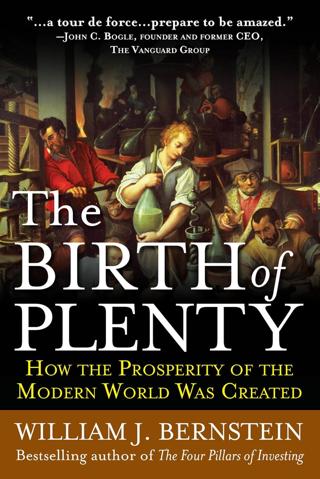
Critical Review of The Birth of Plenty
How the Prosperity of the Modern World was Created
By: William J. Bernstein
"The Birth of Plenty: How the Prosperity of the Modern World was Created" by William J. Bernstein is a well-regarded work that discusses the reasons behind the economic prosperity since the early modern period. Despite its popularity and recognition for providing a broad analysis of economic history, it is not without its criticisms.
One primary criticism is the book's broad-strokes approach, which some argue oversimplifies complex historical and economic processes. By attempting to distill the causes of modern prosperity into four critical elements—property rights, scientific rationalism, capital markets, and efficient communication and transportation—some scholars contend that Bernstein overlooks the nuanced and often non-linear interactions between different social, political, and historical factors that also contributed to economic development.
Another area of critique is the limited consideration of cultural and geographical factors. Critics suggest that Bernstein underestimates how culture and geography might have significantly influenced economic development and prosperity. While he acknowledges these factors to an extent, the book may not sufficiently explore how varying cultural attitudes towards work, innovation, and trade have shaped economic trajectories in different regions. Similarly, geographical advantages, such as access to navigable waterways or resource-rich land, could also play a more substantial role than Bernstein attributes.
Moreover, Bernstein's focus on Western economic history and its successes can be seen as somewhat Eurocentric. Although his analysis is insightful for understanding developments in Europe and North America, critics argue that it does not fully address the global context, including the influence of colonialism, imperialism, and the exploitation of non-Western societies in building Western prosperity. This could lead to a somewhat skewed perspective on "global" economic development.
Lastly, while Bernstein makes a compelling case for the importance of the four elements he identifies, there is criticism about his lack of integration regarding how these elements interacted over time and across different regions. For instance, the relationship between scientific advancement and capital markets might be more complex than the book suggests, and critics argue that a more detailed exploration of these interactions could enhance the analysis. Overall, while "The Birth of Plenty" provides a thought-provoking overview of economic history, these criticisms highlight areas where the narrative could expand or deepen its analysis to account for more varied influences and interactions.
<< Back to the book summary