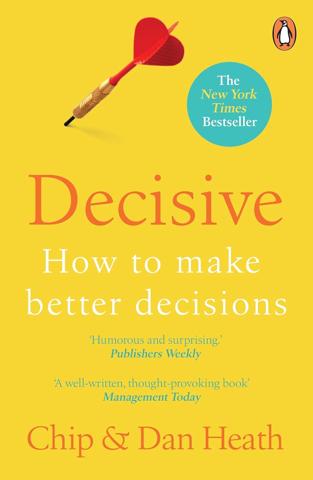
Critical Review of Decisive
How to make better choices in life and work
By: Chip Heath, Dan Heath
"Decisive: How to Make Better Choices in Life and Work" by Chip Heath and Dan Heath is generally well-regarded for its practical approach to decision-making. Nevertheless, like any popular psychology or self-help book, it has faced some criticism, particularly from a scientific and scholarly perspective.
One common critique is that while the book is rich in anecdotes and practical tips, it may oversimplify complex psychological and cognitive processes. Critics argue that decision-making is often influenced by subconscious factors that are not easily addressed through the structured methodologies proposed by the authors. The book's framework emphasizes being systematic and deliberate but may overlook the nuanced and sometimes irrational nature of human cognition, as identified in more robust psychological studies.
Another point of critique is the limitation posed by its reliance on storytelling and case studies as evidence. While these narratives make the book engaging and relatable, they might not always align with scientific rigor. Critics highlight that anecdotal evidence lacks the statistical power and replicability of peer-reviewed research. This reliance can lead to overgeneralizing specific examples to a larger audience without empirical validation, raising questions about the applicability of their advice across diverse contexts.
Furthermore, some scientific critics may also point out that the book, like many in the self-help genre, could underappreciate the role of external factors such as environment, cultural influences, and systemic constraints in decision-making. By focusing primarily on individual agency, the book might inadvertently suggest that poor decisions are solely due to personal failings, overlooking how societal structures can limit or enhance options.
Lastly, the application of the book's strategies in scientific or medical decision-making, which often involves dealing with vast amounts of uncertain information, can be disputed. Complex decisions in these fields require balancing intuition, empirical data, and ethical considerations, which might not neatly fit into the model the Heath brothers propose. Thus, while the book presents useful tools for clearer thinking and better personal and business decisions, its methods might not fully accommodate the intricacies of decision-making in all professional domains.
<< Back to the book summary