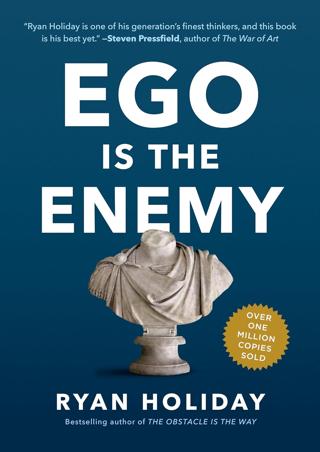
Critical Review of Ego Is the Enemy
By: Ryan Holiday
"Ego Is the Enemy" by Ryan Holiday has received various feedback from both readers and critics since its publication. While the book is praised for its accessible writing style and practical advice, there are some criticisms from a scientific and scholarly perspective.
One major scientific critique of "Ego Is the Enemy" is that it relies heavily on anecdotal evidence and historical anecdotes rather than empirical research. Holiday draws upon various historical figures as examples to illustrate the dangers of letting ego cloud judgment, but some critics argue that this approach lacks the rigor and validity of evidence-based research. Anecdotes are often used in the book to make points about human behavior and psychology, which can be compelling but do not establish causation or comprehensively account for the complexity of human nature.
Furthermore, critics have pointed out that Holiday’s analysis of the concept of "ego" can be somewhat oversimplified. Psychological literature presents the ego as a multifaceted construct, deeply rooted in different schools of thought such as Freudian theory, where it plays a critical role in balancing instincts and moral values. Holiday’s interpretation, focusing primarily on the negative aspects of ego as an obstacle to success and fulfillment, may overlook its potential positive aspects. In psychology, ego can be associated with self-esteem, confidence, and the ability to assert oneself, which are not inherently negative traits and can contribute positively to personal development when managed properly.
Another critique is the book’s lack of integration with contemporary psychological theories and research. While Holiday references Stoic philosophy and pulls examples from history, there is less engagement with modern psychology and how it understands ego-related behavior in today's context. The inclusion of recent scientific studies on personality, self-perception, and motivation would strengthen the arguments made in the book by aligning them more closely with what is known from research.
Lastly, some readers feel that the book presents its ideas in a rigid, one-size-fits-all manner, not accounting for the complexities and individual differences in human behavior. Critics underscore that personal development and self-management strategies should be tailored to each individual’s personality and life circumstances. Holiday’s narrative approach, while motivational, may not fully acknowledge the nuanced nature of personal growth and psychological health, potentially leaving some readers feeling that the advice is too generalized for their specific needs.
<< Back to the book summary