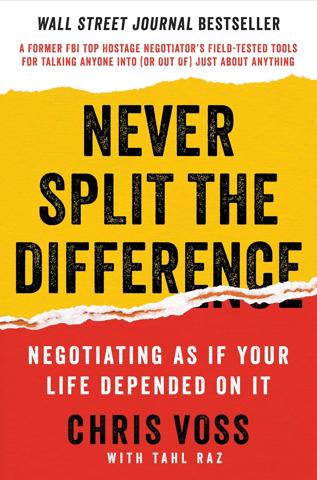
Never Split the Difference
Negotiating As If Your Life Depended On It
By: Chris Voss, Tahl Raz
Intro:
"Never Split the Difference: Negotiating As If Your Life Depended On It" by Chris Voss, with Tahl Raz, is a thought-provoking guide that transforms the art of negotiation into a science. Drawing on his decades of experience as an FBI hostage negotiator, Voss offers readers a unique perspective on the high-stakes world of negotiation and conflict resolution. The book challenges conventional negotiation techniques, presenting strategies that focus on emotional intelligence and deep listening, rather than compromise and concession. By sharing real-life stories from his career, Voss demonstrates how lessons learned in crisis situations can be applied to everyday business and personal negotiations. Voss advocates for the use of "tactical empathy" to effectively engage with others and influence outcomes. He introduces tools such as the "mirroring technique," the "accusation audit," and "the black swan concept," all designed to uncover hidden information and reshape negotiations in one's favor. These techniques emphasize understanding the counterpart's perspective and uncovering underlying motivations, leading to more strategic and successful interactions. Through a focus on psychological principles and human behavior, Voss empowers readers to master negotiations by shaping and steering conversations with skill and confidence. The book is both a practical manual and a fascinating dive into the world of a former top-level FBI negotiator. Readers are guided through various scenarios, from high-stakes corporate deals to tense interpersonal exchanges, and equipped with a versatile set of tools that can be adapted to any situation. "Never Split the Difference" ultimately transforms the way we approach the act of negotiating, instilling a mindset that values preparation, empathy, and a keen understanding of human dynamics, ultimately aiming for resolution and success without unnecessary compromise.
Never Split the Difference: Negotiating As If Your Life Depended On It is a book by former FBI hostage negotiator Chris Voss.
It offers a breakdown of negotiation tactics based on Voss's real-world experiences in high-stakes bargaining scenarios. Here's a chapter-by-chapter summary:
Introduction
The introduction establishes Chris Voss’s credibility by detailing his experiences as a top FBI hostage negotiator. It sets the stage for a new approach to negotiation that moves beyond the rational and analytical methods typically taught in business schools.
Chapter 1: The New Rules
Voss discusses the limitations of traditional negotiation tactics and introduces his own approach, which emphasizes understanding emotions and thinking like a hostage negotiator. He argues for the importance of empathy and being able to interpret the information that isn't being said explicitly.
Chapter 2: Be a Mirror
This chapter introduces the concept of “mirroring,” which involves simple repetition to establish rapport and trust. Voss explains how people are often drawn to things that are similar to themselves and how mirroring can yield more information from the other person.
Chapter 3: Don’t Feel Their Pain, Label It
Voss introduces the tactic of “labeling,” which involves identifying and acknowledging the emotions of your counterpart. By doing this, you can defuse negative emotions and create a safer space for negotiation.
Chapter 4: Beware “Yes”—Master “No”
In this chapter, Voss challenges the common obsession with getting someone to say "yes." Instead, he emphasizes the power of "no," explaining that it is a starting point that allows you to uncover objections and deeper truths behind the counterpart’s motives.
Chapter 5: Trigger the Two Words
That Immediately Transform Any Negotiation Here, Voss explains the significance of eliciting the phrase "That's right" from the counterpart. This phrase signals that they feel understood, which is crucial for building trust and moving negotiations forward.
Chapter 6: Bend Their Reality
Voss discusses techniques for shaping the perceived value of an offer. He introduces concepts such as anchoring, loss aversion, and creating the illusion of control to influence the counterpart's decision-making. ### Chapter 7: Create the Illusion of Control This chapter focuses on using calibrated questions to maintain control while giving the counterpart the illusion that they are in charge. Open-ended questions beginning with "what" or "how" are ideal for this purpose.
Chapter 8: Guarantee Execution
Voss explores how to ensure follow-through on agreed terms. He highlights the importance of understanding the other party's constraints and motivations, and establishing clear, actionable next steps.
Chapter 9: Bargain Hard
This chapter delves into bargaining techniques. Voss explains the importance of being assertive, using emotional intelligence, and maintaining a tactical empathy to push negotiations to a close successfully.
Chapter 10: Find the Black Swan
Voss introduces the concept of the "Black Swan," which are hidden pieces of information that can change the course of a negotiation. He emphasizes the importance of embracing the unexpected and being adaptable.
Conclusion: The Proof of Life
In the conclusion, Voss ties together the lessons learned throughout the book and reinforces the notion that negotiation is a skill relevant in all aspects of life, not just in high-stakes or professional scenarios. He encourages readers to continue practicing and refining their negotiation skills. Throughout "Never Split the Difference," Voss intertwines personal anecdotes with actionable insights, making the book both engaging and educational for anyone looking to improve their negotiation abilities.