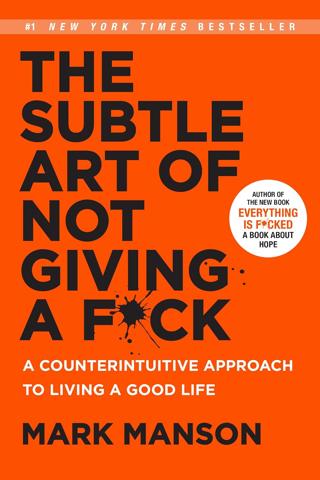
The Subtle Art of Not Giving a F*ck
A Counterintuitive Approach to Living a Good Life
By: Mark Manson
Intro:
"The Subtle Art of Not Giving a F*ck: A Counterintuitive Approach to Living a Good Life" by Mark Manson offers a refreshing take on personal development by challenging conventional self-help advice. Instead of advocating for relentless positivity, Manson encourages readers to embrace life's challenges and prioritize what truly matters. By acknowledging our limitations and focusing our energy on what aligns with our values, we can lead more meaningful and fulfilling lives. With humor and raw honesty, Manson shifts the paradigm of happiness, suggesting that the key to a good life lies not in the absence of problems but in the careful selection of the ones we choose to tackle.
The book The Subtle Art of Not Giving a F*ck by Mark Manson provides a fresh perspective on living a meaningful life by encouraging readers to focus on what truly matters. Manson emphasizes that caring too much about things that do not align with our core values can lead to unhappiness and stress. By selectively choosing where to place our values and attention, we can live more fulfilling lives.
Chapter 1: Don’t Try
This chapter opens with the story of Charles Bukowski, a writer who was considered a failure by many social standards but found success by accepting his true self. Manson introduces the idea that life is filled with failures, and the key is to not try incessantly to avoid them. He argues that it's important to understand what is worth struggling for in life. By learning to prioritize and care about less trivial things, one can redirect energy toward more meaningful pursuits.
Manson emphasizes the importance of embracing life's inevitable challenges and limitations. He suggests that instead of trying to avoid pain, we should accept its presence and focus on what is meaningful and important. Understanding what you don't give a "f*ck" about enables you to concentrate on what truly deserves your attention.
Chapter 2: Happiness is a Problem
Here, Manson describes how our pursuit of happiness can often lead to dissatisfaction. He discusses the concept of the 'hedonic treadmill', where pursuing more success and pleasure only results in a continual return to a baseline of dissatisfaction. The chapter underlines the idea that happiness comes from solving problems, encouraging readers to find joy in the process of facing life's inevitable challenges.
The chapter suggests that the key to a good life is not picking the right set of problems but to be satisfied with the process of solving problems. Manson insists that it is our values that determine what kind of problems we have, thus making it critical to choose and evaluate our values wisely, as they will affect our satisfaction with life.
Chapter 3: You Are Not Special
Manson challenges the notion of being inherently exceptional, which he argues creates unrealistic expectations and fosters entitlement. This entitlement manifests as a belief that one deserves better circumstances without earning them. Manson suggests that true self-improvement does not stem from feeling extraordinary but from accepting one's average existence and working within it.
The chapter advocates for humility and encourages readers to accept normativity rather than viewing oneself as uniquely deserving. Manson argues that accepting one's limitations and the reality of one's ordinariness paves the way for growth and the pursuit of genuine value-based goals.
Chapter 4: The Value of Suffering
This chapter poses the question, "What pain do you want in your life?" to highlight the concept of choosing how we suffer through the problems we choose. Manson suggests that enduring meaningful pain leads to more satisfying results, and choosing values that create beneficial rather than harmful suffering is crucial.
Manson dives into how accepting and embracing the pain that comes from valuable pursuits allows individuals to live more fulfilling lives. By understanding that suffering is inevitable, we free ourselves to choose which pains are worth enduring by selecting our values and pursuits wisely.
Chapter 5: You Are Always Choosing
The idea that personal responsibility is central to the book is underscored here. Manson discusses that although individuals cannot control everything in their lives, they can control how they react to circumstances. Accepting responsibility for one's life's outcomes is empowering and essential to personal growth.
Manson argues that freedom and empowerment come from accepting one's responsibilities and understanding that one can control their choices and their subsequent impact. This notion encourages readers to accept responsibility for their happiness and find opportunities for change in the choices they make.
Chapter 6: You’re Wrong About Everything
The sixth chapter centers around embracing uncertainty and doubt as paths to knowledge and understanding. Manson posits that humans are fallible and entrenched in a lifetime of wrong beliefs and values, and accepting this could lead to personal development.
By framing personal growth as a process of continually acknowledging and correcting misconceptions, Manson stresses the value of open-mindedness and the constant reevaluation of beliefs. He advocates for the courage to question everything, as this vulnerability is a source of strength and personal growth.
Chapter 7: Failure Is the Way Forward
Failure serves as a key component to progress in this chapter. Manson argues that our failures teach us more profound lessons than success can; by redefining failure as an integral aspect of success, we develop resilience.
Manson suggests that people should dare to take action even in the face of risk and potential failure, highlighting that action breeds motivation, not the other way around. The act of moving towards challenges, despite the possibility of failure, drives personal progress and fulfillment.
Chapter 8: The Importance of Saying No
Manson explores the significance of setting boundaries and learning to say no. By deciding what we do not value, we can focus more on the things that are truly important to us. This principle echoes the book’s theme of prioritization—choosing what to care about selectively.
This selection process leads to healthier relationships, clearer goals, and increased personal freedom. Manson underscores that life gets easier and more fulfilling when one learns to assert personal values and make meaningful choices by saying no to things that conflict with them.
Chapter 9: ...And Then You Die
The final chapter grapples with the concept of mortality. Manson points out that confronting death is essential to living life fully. By contemplating our mortality, we can better appreciate the time we have and prioritize our lives around our true values.
Manson concludes by encouraging readers to acknowledge their temporary existence and utilize this awareness to focus on what genuinely matters. This reflection provides a powerful impetus to lead a value-driven life, focusing on the transient but meaningful experiences that provide lasting fulfillment.
The subtle art of not giving a f*ck involves freeing oneself from societal pressures and focusing instead on living a life aligned with personal values. By selectively choosing what to value and care about, we can gain more happiness, fulfillment, and life satisfaction.