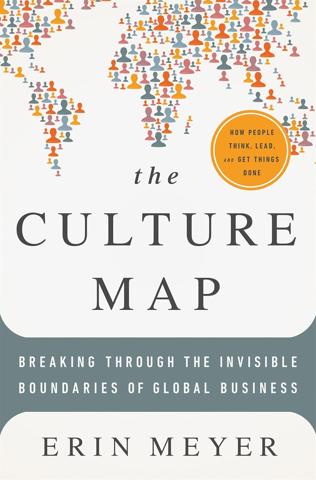
The Culture Map
Breaking Through the Invisible Boundaries of Global Business
By: Erin Meyer
Intro:
"The Culture Map: Breaking Through the Invisible Boundaries of Global Business" by Erin Meyer is an insightful exploration of how cultural differences impact international business interactions. Meyer, a renowned expert on cross-cultural communication, draws on extensive research and real-life case studies to illustrate how cultural nuances influence communication styles, negotiation tactics, decision-making processes, and leadership approaches. The book serves as a practical guide for managers and professionals navigating the complexities of global business, offering tools to decode cultural behaviors and foster more effective collaboration across diverse cultural landscapes. By bridging these invisible boundaries, readers can enhance their intercultural competence and improve their effectiveness in an increasingly interconnected world.
The Culture Map by Erin Meyer is an insightful guide that explores the complexities of navigating cultural differences in a global business environment. The book lays out a framework that helps individuals and businesses enhance their cross-cultural communication, avoiding misunderstandings and misinterpretations in international settings. Here's a detailed summary of each chapter in the book:
Chapter 1: Listening to the Air - Communicating Across Cultures
In the first chapter, Meyer introduces the concept of communication styles, emphasizing the difference between low-context and high-context cultures. Low-context cultures prefer direct, explicit communication, while high-context cultures rely more on the underlying context, non-verbal cues, and implied meanings. Meyer uses examples from various cultures to highlight how different communication styles can lead to misunderstandings and stresses the importance of adjusting one's style to bridge these gaps.
Chapter 2: The Many Faces of Polite - Evaluating Performance and Providing Feedback
This chapter focuses on how different cultures give feedback. Meyer explains that some cultures are more direct, giving straightforward negative feedback (e.g., the Dutch), whereas others are more indirect (e.g., the Japanese). She illustrates how the balance of negative and positive feedback varies across cultures and suggests strategies for giving feedback in a manner that respects cultural norms.
Chapter 3: Why Versus How - The Art of Persuasion in a Multicultural World
Meyer delves into the persuasive styles of different cultures. She categorizes them into principles-first reasoning (deductive) and applications-first reasoning (inductive). This chapter emphasizes the significance of understanding the dominant reasoning style in different cultures to effectively convey messages and persuade people in a global context.
Chapter 4: How Much Respect Do You Want? - Leadership, Hierarchy, and Power
This chapter explores the role of power distance in organizations, comparing flat and hierarchical cultures. Meyer explains how respect and authority are perceived differently across cultures and discusses the impact these perceptions have on leadership styles, decision-making, and management practices.
Chapter 5: Big D or Little d - Who Decides, and How?
In this chapter, the decision-making processes of various cultures are examined. Meyer explains consensual versus top-down decision-making cultures and reflects on how timing, group dynamics, and individual influence affect decisions within different cultural frameworks. She provides guidance on adapting to these differences in business settings.
Chapter 6: The Head or the Heart - Two Types of Trust and How They Grow
Meyer discusses cognitive trust (trust from the head) versus affective trust (trust from the heart) and how these forms are valued differently across cultures. She delves into relationship-building techniques and emphasizes the necessity of understanding trust dynamics to foster effective international partnerships.
Chapter 7: The Needle, Not the Knife - Disagreeing Productively
This chapter addresses intercultural conflict resolution and disagreement. Meyer contrasts cultures that avoid direct confrontation with those that view open disagreement as a healthy part of communication. She offers strategies to manage and navigate disagreements across cultures productively.
Chapter 8: How Late Is Late? - Scheduling and Cross-Cultural Perceptions of Time
In the final chapter, Meyer examines how different cultures perceive time and schedule management, highlighting linear time versus flexible time perspectives. She provides insights into how these perceptions influence punctuality, project planning, and time management in a multicultural environment.
Overall, The Culture Map serves as an essential tool for anyone working in or with multicultural teams. Erin Meyer provides practical advice and an accessible framework to better understand and navigate the complex landscape of global business, emphasizing that cultural awareness is crucial for achieving successful and harmonious international collaboration.