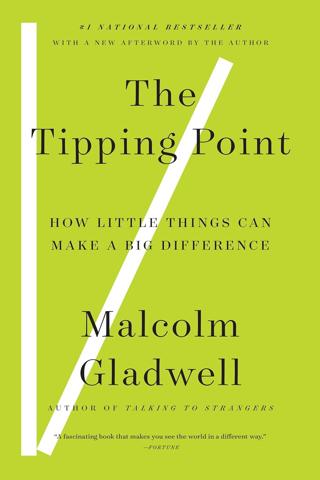
The Tipping Point
How Little Things Can Make a Big Difference
By: Malcolm Gladwell
Intro:
"The Tipping Point: How Little Things Can Make a Big Difference" by Malcolm Gladwell explores the fascinating phenomenon where small actions or changes can lead to significant effects, much like the moment an epidemic reaches its critical mass. Gladwell delves into the mechanics of social epidemics, examining how ideas, behaviors, and products can spread rapidly through society. Interweaving case studies and insights from psychology and sociology, the book identifies key elements like the role of connectors, mavens, and salesmen in societal shifts. Gladwell's engaging narrative challenges readers to look for the subtle forces that drive change and influence trends, offering a compelling analysis of how minor adjustments can create major impacts.
Introduction
In the introduction, Malcolm Gladwell introduces the concept of the "tipping point," which refers to the moment when an idea, trend, or social behavior crosses a threshold and spreads like wildfire. Gladwell sets the stage for exploring how small changes can trigger widespread social epidemics.
Chapter 1: The Three Rules of Epidemics
This chapter introduces the three key agents of change: The Law of the Few, The Stickiness Factor, and The Power of Context. Gladwell argues that these elements are crucial in understanding how ideas spread and what makes a tipping point occur.
The Law of the Few
According to the Law of the Few, a small number of people, whom Gladwell calls Connectors, Mavens, and Salesmen, are essential in spreading ideas and trends.
The Stickiness Factor
The Stickiness Factor refers to the specific content of a message that renders it memorable and impactful.
The Power of Context
The Power of Context suggests that human behavior is highly sensitive to and influenced by its environment.
Chapter 2: The Law of the Few
Gladwell delves deeper into the types of people who are instrumental in creating tipping points. He describes Connectors, who know a large number of people across different social circles; Mavens, who accumulate knowledge and share it with others; and Salesmen, who are persuasive and charismatic individuals capable of promoting new ideas effectively.
Chapter 3: The Stickiness Factor
This chapter examines what makes messages memorable. Gladwell introduces real-world examples, such as children's television shows like "Sesame Street" and "Blue's Clues," to illustrate how slight modifications in presentation can significantly enhance the stickiness of a message.
Chapter 4: The Power of Context (Part One)
Gladwell discusses how the environment plays a pivotal role in determining whether a tipping point will occur. He uses examples such as the crime drops in New York City during the 1990s, attributing this to subtle shifts in the urban environment rather than to broader societal changes.
Chapter 5: The Power of Context (Part Two)
Continuing from the previous chapter, Gladwell explores the psychological and social factors that amplify the Power of Context. He emphasizes the crucial role of groups and social dynamics—highlighting research such as the Stanford prison experiment—to demonstrate how context can significantly alter individual behavior.
Chapter 6: Case Study: Rumors, Sneakers, and the Power of Translation
This chapter demonstrates the principles discussed earlier through case studies. Gladwell examines how rumors spread, what influenced the reformation of the Airwalk sneaker brand, and how a translation of ideas occurs between different groups.
Chapter 7: Case Study: Suicide, Smoking, and the Search for the Unsticky Cigarette
This chapter considers how teenagers experiment and how tipping points can have dangerous consequences. Gladwell analyzes phenomena such as teenage smoking and explores how the principles of social epidemics apply to these serious issues.
Conclusion: The Tipping Point
In the conclusion, Gladwell synthesizes the insights from the book and reaffirms the potency of understanding tipping points. He suggests that by leveraging the concepts of the Law of the Few, the Stickiness Factor, and the Power of Context, individuals and organizations can effectively catalyze change.
The Tipping Point challenges readers to reconsider how they perceive trends and behavioral changes—encouraging a deeper recognition of the small, yet pivotal, elements that can lead to large-scale impacts.