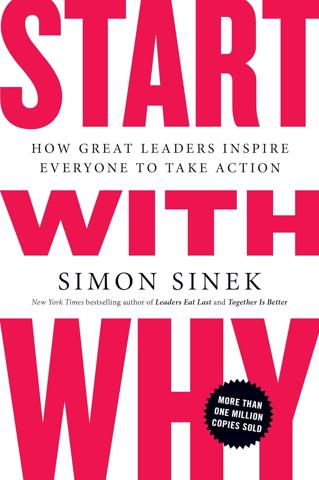
Start with Why
How Great Leaders Inspire Everyone to Take Action
By: Simon Sinek
Intro:
Start with Why by Simon Sinek is a transformative book that explores the power of purpose and inspiration in leadership and business. Sinek introduces the concept of the "Golden Circle," emphasizing the importance of starting with "Why"—the core belief or purpose that drives actions—before addressing "How" and "What." Through compelling examples from successful leaders and organizations, he demonstrates how clarity of purpose fosters trust, loyalty, and long-term success. The book challenges readers to rethink their approach to leadership, encouraging them to inspire others by communicating their deeper motivations and vision.
Introduction
The introduction lays the groundwork for the concepts discussed in the book, introducing the Golden Circle model which consists of three layers: Why, How, and What. Sinek emphasizes the importance of starting with 'Why' as it drives inspiration and leadership.
Chapter 1: Assume You Know
This chapter discusses assumptions and how they can prevent us from understanding our true motivations and principles. Sinek uses real-world examples to illustrate how starting with Why can lead to success and clarity in business decisions.
Chapter 2: Carrots and Sticks
Sinek explores the concept of manipulations versus inspirations. He argues that incentives like promotions and discounts can be effective in the short term but don't create loyalty. True loyalty is built on inspiration, which is rooted in Why.
Chapter 3: The Golden Circle
This chapter delves deeper into the Golden Circle model. Sinek explains how successful leaders and organizations naturally operate from the inside out of this circle, starting with Why, then How, and finally What.
Chapter 4: This Is Not Opinion, This Is Biology
Sinek connects the Golden Circle to biology, explaining how different parts of the brain correspond to each part of the circle. The limbic brain, which handles feelings and decision-making, resonates with Why, while the neocortex relates to What.
Chapter 5: Clarity, Discipline, and Consistency
This chapter covers the importance of having a clear Why, disciplined How's, and consistent What's. Sinek emphasizes that if any part of this alignment is missing, it can lead to confusion and mistrust.
Chapter 6: The Emergence of Trust
Trust is the result of delivering on promises and operating consistently according to one's Why. Sinek explains how trust is established when people share a common set of values and beliefs.
Chapter 7: How a Tipping Point Tips
Sinek describes how something becomes a tipping point through the Law of Diffusion of Innovations. He explains how influential leaders can inspire action and create change by appealing to early adopters who share the same beliefs.
Chapter 8: Start with Why, but Know How
This chapter addresses the balance between the Why and the How. While the Why provides the foundation, the How is necessary for execution. Sinek highlights the importance of pairing visionaries with those who can implement their ideas.
Chapter 9: Know Why; Know How; Then What?
In discussing the What, Sinek stresses that what organizations do should be consistent with their Why. The What is the tangible proof of the Why, necessary for conveying purpose and creating tangible outcomes.
Chapter 10: Communication Is Not About Speaking, It's About Listening
Sinek emphasizes the importance of listening and how communicating starts by understanding who you’re communicating with. Effective leaders listen to those they lead which allows them to inspire action.
Chapter 11: When Why Goes Fuzzy
This chapter details the consequences of losing sight of Why. Sinek explains how losing focus can lead organizations to make decisions that ultimately result in inconsistency and loss of trust.
Chapter 12: Split Happens
In the final chapter, Sinek illustrates how over time, splits can happen between Why and How within organizations. He details strategies to realign and prevent splits, maintaining unity and consistency.
Conclusion
The book concludes with the reinforcing idea that people don't buy what you do, they buy why you do it. By staying true to your Why, you can inspire those around you and bring more fulfillment to your work.